
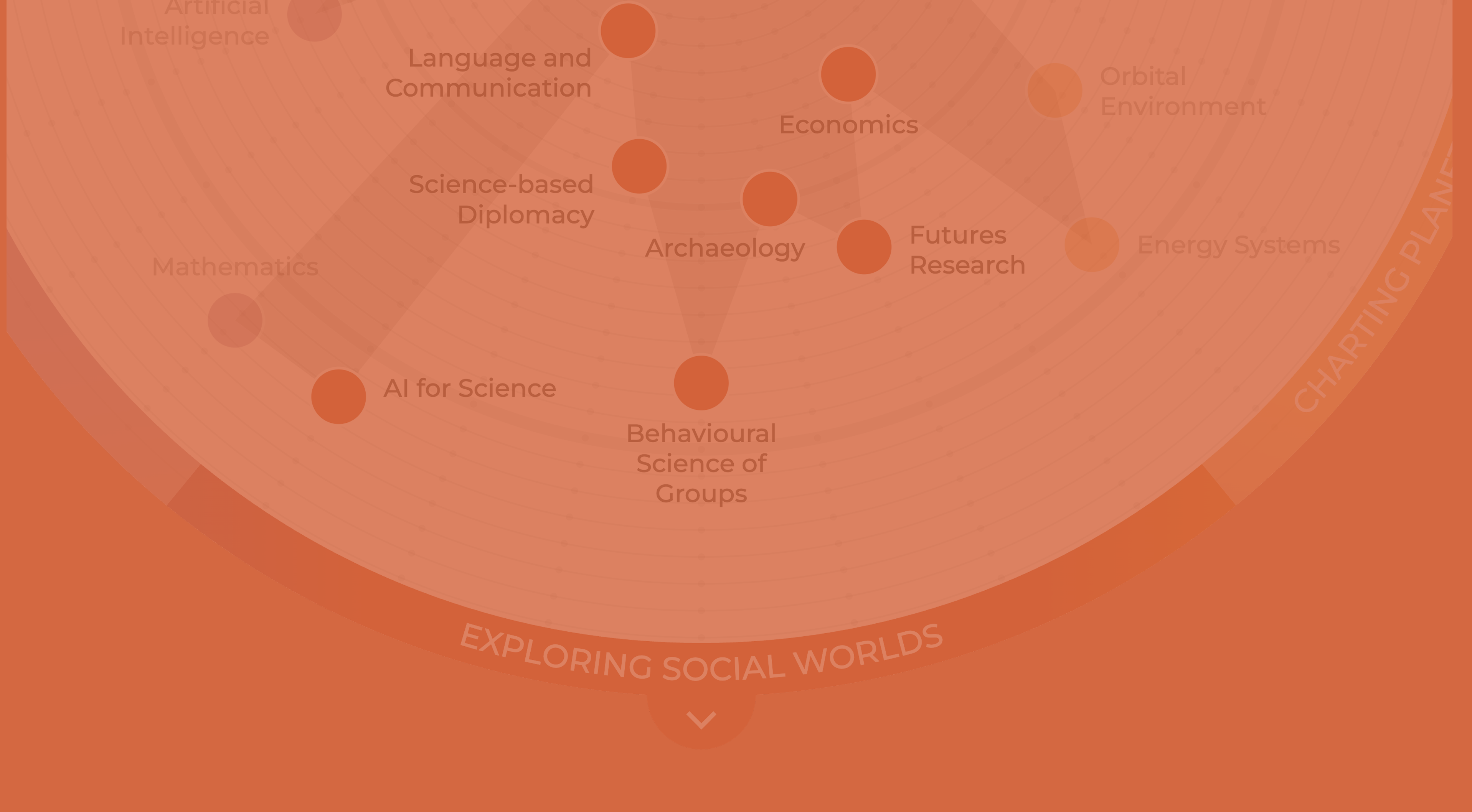
Today this field is being reshaped by large language models alongside the empirical study of multilingualism, animal communication and the evolutionary origins of human speech. The behavioural science of groups moves the inquiry into collective dynamics, using granular data and machine learning to model conflict, cooperation and the formation of social bonds at scales previously inaccessible. Economics applies a similar analytic turn to the institutional infrastructure of social life, reckoning with the limits of rational-actor models and the planetary boundaries within which economies operate. Futures research resolutely shifts the methodological orientation towards anticipation, evolving quantitative forecasting models toward plural, participatory and qualitatively-grounded ways of imagining possible worlds. Science-based diplomacy carries the same orientation into the practice of international coordination, bringing computational methods to the analysis of negotiation, peacebuilding and global governance. AI for science, finally, enters the social practice of science itself, generating hypotheses, running autonomous experiments and contributing to discoveries in mathematics, physics and the life sciences.
What unites the topics of this theme is an object of study that is at once shaping and being reshaped by science and technology advances: the social. What we are as societies, how we communicate within and across them, and how we make sense of the human past, present and future, are all undergoing transformations. These transformations have been induced by new computational tools, new data and new candidates for what counts as a social actor, but are also simultaneously shaping how these devices get deployed in, and appropriated by, social groups of individual humans.
Who are we, as humans?
At the individual level, key transformations concern the relational dimension of who we are as humans – our being human through others, as in Ubuntu philosophy; our political animal condition, in the Aristotelian formulation; our relational self, in the Confucian tradition. We are all, at this level, socially and technologically interdependent beings. Technological artefacts, on the other hand, are always embedded into socio-anthropological contexts made up of collective practices, norms and values, which give these artefacts their cultural meaning (see “Augmenting Human Potential”). This complex relationality implies that changes in our technological environment will reflect on our social structures and practices from specific cultural perspectives and thereby eventually affect our human condition as individuals.
What is specific to the current age is the scale and pace of this reflection. Some emerging science and technologies have the potential to directly reshape basic social structures and practices at their foundations. At stake are several core principles of our interindividual relationships – trust, privacy, friendship, responsibility, accountability, sovereignty – potentially transforming how our social institutions’ norms, values and ideals are consequently implemented on the ground. Fully integrating the situatedness of human agency in this context, where no single agent exists independently but is always embedded within a network of other agents and technologies that co-produce the individual self (see “Designing Machine Realities”), is one of the more consequential reframings now under way.
How can we live together, as societies?
The relational framework can be scaled further. Humans are humans in relation to other humans, and to other living beings, artefacts and the environment. Societies, in this view, are hybrid, containing different actors and agents, from living beings to artefacts, institutions and the environment. What ties us as individuals within societies can no longer be mere geographical or fragile cultural boundaries, but relations and interactions based on interdependence and mutual responsibility. Societies also cut across levels of aggregation: individuals, households, villages, cities; students, classrooms and teachers, educational institutions, and so on, analogously across sectors. Each actor, at each level, has varying degrees of interdependence and responsibility, and the question of how to live together is the question of how these factors are distributed and exercised, and who is held accountable.
The question of how to live together therefore pulls this theme into societal challenges, from climate change through economic inequality to pandemics and malnutrition, that are all globally intertwined. Living together requires addressing these challenges together. However, in times marked by adversarial economic and geopolitical competition, current institutional frameworks are ill-suited for fostering flourishing co-existence on a global scale. That we are still organising our moral commitments and political strategies along the borders of nation states remains a source of deep dysfunctionality and endless fragmentation.
It is easier to diagnose this problem than to solve it. The nation state is largely an invention of the nineteenth century and carries much of its historical baggage: the idea of a national identity defined by a dominant ethnic group, the focus on competition between nations for global influence. But globalisation does not provide a simple remedy for living together at a planetary scale. Rather than fostering mutually beneficial co-existence within and across societies, globalisation risks directing decision-making processes away from people to powerful technocratic organisations and individuals. A transformative perspective for living together needs to be organised across multiple scales, challenging the dominant perspective of the national scale both by scaling down to the local and scaling up to the global.
The conceptual frame for this work need not pitch universalism against relativism. In their generalised forms, both lack legitimacy. We are all members of the same species and therefore share basic bodily structures from our brains to our genes – similar minds emerge from similar bodies, and humans’ affective and cognitive worlds exhibit striking resemblances if described at a sufficient level of abstraction. But describing universal human nature at such a high level of abstraction also runs the risk of flattening the diversity of human experiences and the radically different ways in which human societies organise themselves and engage with their environment. At the same time, pointing to this diversity does not justify cultural relativism as a general doctrine. A more productive framing is one that explores the partial overlaps between knowledge systems, values and worldviews while taking the partialities of such overlaps seriously. It is through the interplay of overlaps and their partialities that we reach beyond simplifying doctrines. Determining what can be universalised on the basis of our shared humanity, while respectfully acknowledging divergent value systems across societal scales, is among the central tasks ahead.
Such a perspective allows us to ask how to facilitate meaningful intercultural dialogue and build multilateral solidarity without downplaying differences and tensions between us. The collective human condition is about our ability to understand each other and struggle together, but also about our diversity and capacity to envision radically different futures. An institutional opportunity runs alongside this. Integrating social contexts made up of a plurality of histories, knowledge traditions and future imaginaries into science and technology-driven approaches to global challenges is critical for enabling collective flourishing in the social worlds we are continuously building.
What is our relationship with the planet?
These social worlds do not stop at the human; they extend to the planetary scale at which human and non-human actors increasingly share futures. As the planetary question returns the social to its environmental embedding, a fairly-distributed responsibility emerges as a key value to ensure a sustainable future across life forms and generations (see “Charting Planetary Frontiers”). On these terms, shaping social worlds is not the application of social science to a fixed object but the active engagement with the relations, institutions and scales through which human and non-human actors can envision a sustainable future on a shared planet.Today this field is being reshaped by large language models alongside the empirical study of multilingualism, animal communication and the evolutionary origins of human speech. The behavioural science of groups moves the inquiry into collective dynamics, using granular data and machine learning to model conflict, cooperation and the formation of social bonds at scales previously inaccessible. Economics applies a similar analytic turn to the institutional infrastructure of social life, reckoning with the limits of rational-actor models and the planetary boundaries within which economies operate. Futures research resolutely shifts the methodological orientation towards anticipation, evolving quantitative forecasting models toward plural, participatory and qualitatively-grounded ways of imagining possible worlds. Science-based diplomacy carries the same orientation into the practice of international coordination, bringing computational methods to the analysis of negotiation, peacebuilding and global governance. AI for science, finally, enters the social practice of science itself, generating hypotheses, running autonomous experiments and contributing to discoveries in mathematics, physics and the life sciences.
What unites the topics of this theme is an object of study that is at once shaping and being reshaped by science and technology advances: the social. What we are as societies, how we communicate within and across them, and how we make sense of the human past, present and future, are all undergoing transformations. These transformations have been induced by new computational tools, new data and new candidates for what counts as a social actor, but are also simultaneously shaping how these devices get deployed in, and appropriated by, social groups of individual humans.
Who are we, as humans?
At the individual level, key transformations concern the relational dimension of who we are as humans – our being human through others, as in Ubuntu philosophy; our political animal condition, in the Aristotelian formulation; our relational self, in the Confucian tradition. We are all, at this level, socially and technologically interdependent beings. Technological artefacts, on the other hand, are always embedded into socio-anthropological contexts made up of collective practices, norms and values, which give these artefacts their cultural meaning (see “Augmenting Human Potential”). This complex relationality implies that changes in our technological environment will reflect on our social structures and practices from specific cultural perspectives and thereby eventually affect our human condition as individuals.
What is specific to the current age is the scale and pace of this reflection. Some emerging science and technologies have the potential to directly reshape basic social structures and practices at their foundations. At stake are several core principles of our interindividual relationships – trust, privacy, friendship, responsibility, accountability, sovereignty – potentially transforming how our social institutions’ norms, values and ideals are consequently implemented on the ground. Fully integrating the situatedness of human agency in this context, where no single agent exists independently but is always embedded within a network of other agents and technologies that co-produce the individual self (see “Designing Machine Realities”), is one of the more consequential reframings now under way.
How can we live together, as societies?
The relational framework can be scaled further. Humans are humans in relation to other humans, and to other living beings, artefacts and the environment. Societies, in this view, are hybrid, containing different actors and agents, from living beings to artefacts, institutions and the environment. What ties us as individuals within societies can no longer be mere geographical or fragile cultural boundaries, but relations and interactions based on interdependence and mutual responsibility. Societies also cut across levels of aggregation: individuals, households, villages, cities; students, classrooms and teachers, educational institutions, and so on, analogously across sectors. Each actor, at each level, has varying degrees of interdependence and responsibility, and the question of how to live together is the question of how these factors are distributed and exercised, and who is held accountable.
The question of how to live together therefore pulls this theme into societal challenges, from climate change through economic inequality to pandemics and malnutrition, that are all globally intertwined. Living together requires addressing these challenges together. However, in times marked by adversarial economic and geopolitical competition, current institutional frameworks are ill-suited for fostering flourishing co-existence on a global scale. That we are still organising our moral commitments and political strategies along the borders of nation states remains a source of deep dysfunctionality and endless fragmentation.
It is easier to diagnose this problem than to solve it. The nation state is largely an invention of the nineteenth century and carries much of its historical baggage: the idea of a national identity defined by a dominant ethnic group, the focus on competition between nations for global influence. But globalisation does not provide a simple remedy for living together at a planetary scale. Rather than fostering mutually beneficial co-existence within and across societies, globalisation risks directing decision-making processes away from people to powerful technocratic organisations and individuals. A transformative perspective for living together needs to be organised across multiple scales, challenging the dominant perspective of the national scale both by scaling down to the local and scaling up to the global.
The conceptual frame for this work need not pitch universalism against relativism. In their generalised forms, both lack legitimacy. We are all members of the same species and therefore share basic bodily structures from our brains to our genes – similar minds emerge from similar bodies, and humans’ affective and cognitive worlds exhibit striking resemblances if described at a sufficient level of abstraction. But describing universal human nature at such a high level of abstraction also runs the risk of flattening the diversity of human experiences and the radically different ways in which human societies organise themselves and engage with their environment. At the same time, pointing to this diversity does not justify cultural relativism as a general doctrine. A more productive framing is one that explores the partial overlaps between knowledge systems, values and worldviews while taking the partialities of such overlaps seriously. It is through the interplay of overlaps and their partialities that we reach beyond simplifying doctrines. Determining what can be universalised on the basis of our shared humanity, while respectfully acknowledging divergent value systems across societal scales, is among the central tasks ahead.
Such a perspective allows us to ask how to facilitate meaningful intercultural dialogue and build multilateral solidarity without downplaying differences and tensions between us. The collective human condition is about our ability to understand each other and struggle together, but also about our diversity and capacity to envision radically different futures. An institutional opportunity runs alongside this. Integrating social contexts made up of a plurality of histories, knowledge traditions and future imaginaries into science and technology-driven approaches to global challenges is critical for enabling collective flourishing in the social worlds we are continuously building.
What is our relationship with the planet?
These social worlds do not stop at the human; they extend to the planetary scale at which human and non-human actors increasingly share futures. As the planetary question returns the social to its environmental embedding, a fairly-distributed responsibility emerges as a key value to ensure a sustainable future across life forms and generations (see “Charting Planetary Frontiers”). On these terms, shaping social worlds is not the application of social science to a fixed object but the active engagement with the relations, institutions and scales through which human and non-human actors can envision a sustainable future on a shared planet.
Associated Topics:

Topic
Economics

Topic
Futures Research
Topic
Archaeology

Topic
Behavioural Science of Groups
Topic
Science-based Diplomacy

Topic
Language and Communication