- Inclusive futures knowledge
- Theories and concepts for plural futures
- Innovative and participatory futures methods
- Accessibility, engagement and action
Sub-Topics
Video
Prediction and Foresight
Modern governments, organisations and businesses planning for our societal, environmental and technological futures frequently depend on forecasting and foresight based on quantitative modelling, predictive data analytics, scenarios and expert workshops to inform futures decision-making.2 Alongside this, claims about the societal impact of emerging technologies such as AI, the metaverse, cryptocurrency or space exploration exert a powerful influence on government policy, organisational strategy and market investments.3,4 Such claims are frequently revealed to be ill-founded or motivated by business interests rather than societal needs, and their agendas can have damaging consequences. Existing approaches to such futures have clearly failed to solve our contemporary challenges and the polycrisis has prompted calls for more and better foresight.5
While existing forecasting and foresight methods provide valuable data, they are limited in scope and depth, often delivered by consultants or through foresight “toolkits”. Recent proposals to improve foresight range from using AI to expand its scale and speed to calls for an inclusive and decolonising foresight agenda.6 A social-sciences, humanities and design approach to futures7,8,9,10,11,12 responds to this context in: assessing the limits of AI in drawing only on existing data, possibly unfit for purpose and requiring careful human guidance;13,14 engaging Global South perspectives (such as, for instance, on Latam-GPT15 and on generational futures16 and feminist, queer, disability and racially and socio-economically minority community perspectives;17 acknowledging Black18 and First Nations futures;19 and applying theory that acknowledges uncertainty and the unknown, and which seeks to shape ethical, realistic and plausible futures.
To achieve credible, precise and responsible decision-making and planning, new foresight which combines qualitative and quantitative knowledge is vital. Both approaches have been honed over decades: quantitative formulas and digital-data analytics deliver convincing models but miss the pivotal role of human values and practices, non-human species and planetary environments in defining futures;20 ,21 and the social sciences, humanities and design apply new rigour and inclusivity through methods that account for how possible futures are shaped and complicated by these qualitative factors.
For society to benefit from qualitative futures knowledge it must be visible, recognisable, accessible and influential in the decision-making sphere. This means: raising the profile of a new tier of engaged qualitative futures researchers and knowledge delivered collaboratively and in partnership with other disciplines and sectors internationally (governments, communities and businesses); and sharing accessible futures reports through scenarios, film-making, exhibitions and performances.22,23
KEY TAKEAWAYS
Anticipating possible futures is critical to policy and planning for governments, organisations and businesses, spurring a growing demand for foresight. Engaged futures scholars across the Global South and North are delivering a vital new layer of qualitative Inclusive futures knowledge. These approaches are designed to inform better decision-making by bringing qualitative and quantitative data together to deepen and enrich insight across multiple sectors. Theories and concepts for plural futures in social-sciences, humanities and design futures acknowledge and address the uncertainty, plurality and contestability of futures. This enhances our capability to shape inclusive, realistic and plausible futures through interdisciplinary, cross-sectoral and stakeholder engagement. Simultaneously, Innovative and participatory futures methods increase the robustness and rigour of inclusive futures research. Engaged qualitative futures research accounts for how futures are shaped by qualitative factors, rather than just relying on quantitative modelling, predictive data analytics, scenarios and foresight workshops. There is growing evidence of success in this approach, but making it available to stakeholders and decision-makers requires Accessibility, engagement and action.

Anticipatory Impact:
Three fundamental questions guide GESDA’s mission and drive its work: Who are we, as humans? How can we all live together? How can we ensure the well-being of humankind and the sustainable future of our planet? We asked researchers from the field to anticipate what impact future breakthroughs could have on each of these dimensions. This wheel summarises their opinions when considering each of these questions, with a higher score indicating high anticipated impact, and vice versa.
- Anticipated impact on who we are as humans
- Anticipated impact on how we will all live together
- Anticipated impact on the well-being of humankind and sustainable future of our planet

Inclusive futures knowledge
Future Horizons:
10-yearhorizon
Qualitative approaches inform decision-making
25-yearhorizon
A bank of qualitative futures knowledge is established
Advances in qualitative approaches to generating futures knowledge are uneven across sectors. As we anticipate a shift towards sustainable clean-energy futures, the energy sector provides one early example of successful implementation. This has led to new accountability to human and societal futures, with benefits in guiding strategy, investment and development. Companies, governments and multilateral bodies have historically depended largely on quantitative knowledge derived from economic forecasts, predictive data analytics and expert opinion to inform energy scenario-building and decision-making around long-term investments in costly infrastructure.24 The inability of these methods to envisage more diverse, inclusive and subsequently realistic and plausible futures has led to a lack of reliable knowledge and a crisis of the imagination.
In response, social sciences, humanities and speculative design have produced accessible new qualitative knowledge to guide decision-makers who realise the need to attend to and account for social and societal futures in the energy sector. This new layer of knowledge has both productively complicated existing assumptions and ensured that the roles of diverse experiences and agencies in shaping futures are ethically and inclusively accounted for. For example, researchers have used qualitative research to revise existing assumptions: where “social acceptance” of energy technologies or interventions has not worked, energy stakeholders have been open to new social-science-evidenced concepts of “social readiness” and “social value”. Other sectors where futures scholars have translated qualitative futures knowledge to address stakeholder challenges are related to city data, education, net-zero transition and commercial product development.
Inclusive futures knowledge - Anticipation Scores
The Anticipation Potential of a research field is determined by the capacity for impactful action in the present, considering possible future transformative breakthroughs in a field over a 25-year outlook. A field with a high Anticipation Potential, therefore, combines the potential range of future transformative possibilities engendered by a research area with a wide field of opportunities for action in the present. We asked researchers in the field to anticipate:
- The uncertainty related to future science breakthroughs in the field
- The transformative effect anticipated breakthroughs may have on research and society
- The scope for action in the present in relation to anticipated breakthroughs.
This chart represents a summary of their responses to each of these elements, which when combined, provide the Anticipation Potential for the topic. See methodology for more information.

Theories and concepts for plural futures
Future Horizons:
5-yearhorizon
Qualitative, quantitative and technical disciplines collaborate
10-yearhorizon
Interdisciplinary theories drive decision-making
25-yearhorizon
Just, sustainable and digital futures arise
Contrastingly, social scientists, humanities and design research theories from the Global South and North, and treat futures as emergent, possible, plural, situated, contingent and not necessarily causal or linear. To embrace the conditions and experiences of futures aligned with this theoretical perspective a series of concepts have been proposed and tested. These include (but are not limited to): uncertainty, trust, hope, anxiety, friction, breakage, repair and aspiration, desirability and utopia. This framework can be used to ask how emerging technologies might be reshaped by the agency of people who use them in society and what this implies for realistic and plausible community futures; or how ethical futures might be shaped when plural preferred futures exist in society, for example in the present dialogue relating to just transitions to net zero-carbon emissions. Often these challenges cannot be solved by linear theories of futures, where technology is thought to simply impact on society or where building adaptive systems is assumed to lead to resilient societies.
Bringing social-science theories and concepts to bear on technical and system solutions can improve our ability to develop plausible, realistic and ethical solutions and achieve goals of inclusive and just futures.
Theories and concepts for plural futures - Anticipation Scores
The Anticipation Potential of a research field is determined by the capacity for impactful action in the present, considering possible future transformative breakthroughs in a field over a 25-year outlook. A field with a high Anticipation Potential, therefore, combines the potential range of future transformative possibilities engendered by a research area with a wide field of opportunities for action in the present. We asked researchers in the field to anticipate:
- The uncertainty related to future science breakthroughs in the field
- The transformative effect anticipated breakthroughs may have on research and society
- The scope for action in the present in relation to anticipated breakthroughs.
This chart represents a summary of their responses to each of these elements, which when combined, provide the Anticipation Potential for the topic. See methodology for more information.

Innovative and participatory futures methods
Future Horizons:
5-yearhorizon
Innovative methods gain traction
10-yearhorizon
Deep interdisciplinarity becomes the norm
25-yearhorizon
Educational and professional spheres embrace new approaches
Qualitative methods innovations tackle the challenge of enabling diverse participants to imagine futures beyond those promoted in dominant narratives.29,30,31 They include: futures-ethnographic techniques where participants are invited to experience and imagine possible futures in situ in their homes or cities (for instance); place-based methods to co-design and reimagine community futures playfully; carefully curated design futures workshops which employ speculative devices such as futures mapping, “thing ethnographies”,32 and generative AI provocations;33 futures card decks; speculative reverse engineering; and futures storytelling and narrative.34,35 The outcomes of these methods include: new accounts of possible future life; provocative personas that challenge dominant assumptions about people; and alternative scenarios and narratives developed with ethnographic evidence that centre voices of those often neglected in imagining futures.36
These qualitative innovations are complementary to existing forecasting and foresight methods and designed to build important relationships and continuums between qualitative and quantitative methods. For instance, the richer, deeper insights that qualitative futures methods produce have been integrated with existing large-scale, quantitative techniques by ensuring surveys include innovative questions derived from in-depth ethnographic and speculative research to validate and reproduce findings at scale. Such approaches can also be used to expose blind spots in prevailing thinking and open up new lines of inquiry.
Qualitative futures methods have had success across social science, humanities and design research focused in, for example, the energy sector, net-zero transitions, education, ageing societies,37,38 Indigenous self-determination, disaster preparedness and city data futures.39 However, these new methods are not familiar in many of the domains where futures thinking and decision-making are currently practised.
Innovative and participatory futures methods - Anticipation Scores
The Anticipation Potential of a research field is determined by the capacity for impactful action in the present, considering possible future transformative breakthroughs in a field over a 25-year outlook. A field with a high Anticipation Potential, therefore, combines the potential range of future transformative possibilities engendered by a research area with a wide field of opportunities for action in the present. We asked researchers in the field to anticipate:
- The uncertainty related to future science breakthroughs in the field
- The transformative effect anticipated breakthroughs may have on research and society
- The scope for action in the present in relation to anticipated breakthroughs.
This chart represents a summary of their responses to each of these elements, which when combined, provide the Anticipation Potential for the topic. See methodology for more information.

Accessibility, engagement and action
Future Horizons:
5-yearhorizon
Qualitative futures reports achieve widespread acceptance
10-yearhorizon
Creative outputs are commonplace
25-yearhorizon
Social and human dimensions of futures decision-making are mainstream
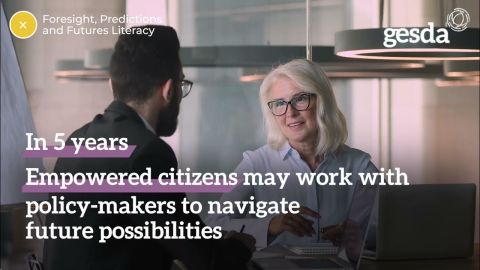
A growing body of clear and accessible qualitative futures knowledge is freely available, backed up by the scholarly integrity and peer review which ensures its quality and rigour. Report series have been carefully designed to communicate accessible findings to industry partners in energy, older-care, construction, mobilities, city and other sectors.40 Creative storytelling,41 comic strips, workshops,42 documentary films,43,44,45,46,47,48 exhibitions or speculative objects and online games49 have been developed. Often co-created with those at stake, these creative works make possible futures present and participatory in tangible and experiential forms, and have been shared across diverse audiences. These formats acknowledge the plurality of global South and North "futurisms" to be accounted for (for instance including feminist futures, Afrofuturism,50 posthumanism and environmental futures). Integrating social-science futures knowledge and theories makes visible the power relations and ethics of shaping futures with diverse communities.
Next steps involve bringing qualitative and quantitative knowledge into closer dialogue to deliver powerful new foresight for decision-makers to cite as the basis for action.
Accessibility, engagement and action - Anticipation Scores
The Anticipation Potential of a research field is determined by the capacity for impactful action in the present, considering possible future transformative breakthroughs in a field over a 25-year outlook. A field with a high Anticipation Potential, therefore, combines the potential range of future transformative possibilities engendered by a research area with a wide field of opportunities for action in the present. We asked researchers in the field to anticipate:
- The uncertainty related to future science breakthroughs in the field
- The transformative effect anticipated breakthroughs may have on research and society
- The scope for action in the present in relation to anticipated breakthroughs.
This chart represents a summary of their responses to each of these elements, which when combined, provide the Anticipation Potential for the topic. See methodology for more information.