- Modelling of feedbacks in the Earth system
- Tipping element modelling and forecasting
- Interactions between earth systems
- Model intercomparison
Sub-Topics
Video
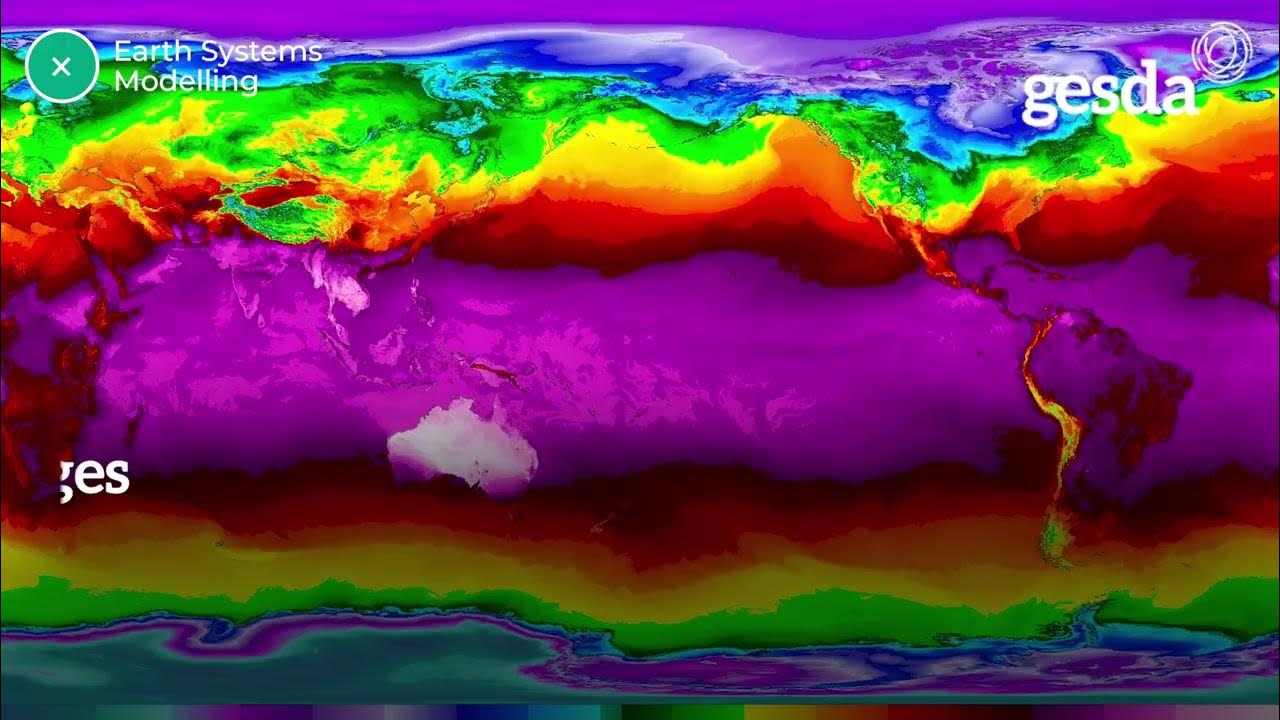
Earth Systems Modelling
The concept of the Earth system can be traced to James Lovelock’s much-discussed Gaia hypothesis, which posited that all of Earth is a self-regulating whole. While aspects of Lovelock’s proposal remain controversial, the core notion has proved correct.
As an example, by including explicit models of the cryosphere, researchers can better predict the extent and speed of sea-level rise. In addition, the models must incorporate the effects of feedback loops, where small changes in one component can trigger effects in others, which then in turn alter the state of the first component, amplifying or diminishing the original change. The Earth-system paradigm has also led to the identification of “tipping elements”. These are components of the Earth system that can undergo effectively irreversible change given a sufficiently strong stimulus.
Earth-system models that can handle these interactions are necessarily extremely complex. One key enabler is the development of ever-more-powerful supercomputers. However, a crucial task is to ground them in observations of real-world systems, and in process-oriented studies that capture the mechanisms of the Earth system. This requires significant increases in monitoring capacity, using both terrestrial and space-based sensors. Strategic improvements in Earth remote sensing would bolster our understanding of the Earth system and ability to forecast societally relevant changes.
KEY TAKEAWAYS
Earth-systems models are a set of extremely complex models of the various interacting systems operating on our planet. They provide a means of anticipating future trends and events. However, their complexity means that the models are far from perfect, despite the powerful supercomputing resources now available to run them. One of the challenges lies in the Modelling of feedbacks in the Earth system. An example is the increased global warming through absorption of solar radiation that results from receding sea ice — the recession itself is a result of global warming. Such feedbacks may eventually lead to “tipping elements”, such as the potential for the Amazon rainforest to be suddenly transformed into a savannah. Tipping element modelling and forecasting is also a significant challenge. It is, however, a vital one to address, since uncertainties here leave our models exposed to sudden and potentially catastrophic deviation from real-world scenarios. Also significant are the Interactions between Earth systems. Understanding the links between climate change and biodiversity loss, for example, can assist in the timely and effective management of habitats. While all the computational models of Earth’s systems have flaws, these can be mitigated in part by Model intercomparison. This can improve model reliability by comparing the performance of ensembles of models and weighting their contributions accordingly.
Anticipatory Impact:
Three fundamental questions guide GESDA’s mission and drive its work: Who are we, as humans? How can we all live together? How can we ensure the well-being of humankind and the sustainable future of our planet? We asked researchers from the field to anticipate what impact future breakthroughs could have on each of these dimensions. This wheel summarises their opinions when considering each of these questions, with a higher score indicating high anticipated impact, and vice versa.
- Anticipated impact on who we are as humans
- Anticipated impact on how we will all live together
- Anticipated impact on the well-being of humankind and sustainable future of our planet

Modelling of feedbacks in the Earth system
Future Horizons:
10-yearhorizon
Models include cloud influence
25-yearhorizon
High-resolution modelling and exascale computing improves prediction
In recent years, there has been more concern about cloud feedbacks. High-resolution climate simulations show that low-lying stratocumulus clouds will break up in a warmer climate, reducing their shading effect and allowing for greater warming.1 This is significant, because these clouds are common in the tropics, shading 20 per cent of low-latitude oceans.
Better modelling of such feedback mechanisms, especially through refinement against observational data, can help us understand these risks and improve the fidelity of our climate models. In recent years, for example, researchers have successfully reconstructed the history of the Atlantic Meridional Overturning Circulation (AMOC) going back over a century.2 This means it is now possible to put observations of current AMOC changes into their long-term context — and this suggests that the AMOC is indeed slowing.3 This may, in the near term, increase the overall warming at the surface.4
Models also need to take more account of ecosystem feedbacks, such as those from the melting of permafrost (an event that could release large quantities of greenhouse gases, potentially accelerating and increasing the warming trend5), climate-induced human migration and coral bleaching, all of which can have feedback effects on climate systems.
Modelling of feedbacks in the Earth system - Anticipation Scores
The Anticipation Potential of a research field is determined by the capacity for impactful action in the present, considering possible future transformative breakthroughs in a field over a 25-year outlook. A field with a high Anticipation Potential, therefore, combines the potential range of future transformative possibilities engendered by a research area with a wide field of opportunities for action in the present. We asked researchers in the field to anticipate:
- The uncertainty related to future science breakthroughs in the field
- The transformative effect anticipated breakthroughs may have on research and society
- The scope for action in the present in relation to anticipated breakthroughs.
This chart represents a summary of their responses to each of these elements, which when combined, provide the Anticipation Potential for the topic. See methodology for more information.

Tipping element modelling and forecasting
Future Horizons:
5-yearhorizon
Permafrost influence is better understood
10-yearhorizon
AI assists tipping-event analysis
25-yearhorizon
Model-based monitoring of tipping-event warnings
In the cryosphere, one of the most immediate risks is to the Greenland ice sheet. Recent evidence suggests that this system could be near its tipping point, with about 7 metres of sea-level rise likely to ensue over the coming centuries.6 However, as with all tipping points, limited real-world data combined with the weaknesses of current climate models leave a high degree of uncertainty over exactly how much of a “push” is required.
Models also show that the Amazon rainforest can irreversibly “flip” from forest to savannah. This would be a catastrophic shift, accelerating climate change7 and fuelling more warming.8 The permafrost regions of the far north are also thought to be a tipping element and recent studies indicate this tipping point may be closer than thought.9 Collapse of the permafrost will release large quantities of greenhouse gases, accelerating and increasing the warming trend.
The current generation of Earth-system models struggle to adequately resolve these tipping elements in many cases.10 Some models omit them entirely, making the accurate inclusion of tipping elements an important focus for reducing the ambiguity of model-based climate predictions. The best-modelled tipping elements are those, like the Greenland ice sheet, that primarily depend on inanimate physical objects: tipping elements that include biosphere components, such as the Amazon, are a significantly bigger challenge and require substantial ground-truthing with observations.
Tipping element modelling and forecasting - Anticipation Scores
The Anticipation Potential of a research field is determined by the capacity for impactful action in the present, considering possible future transformative breakthroughs in a field over a 25-year outlook. A field with a high Anticipation Potential, therefore, combines the potential range of future transformative possibilities engendered by a research area with a wide field of opportunities for action in the present. We asked researchers in the field to anticipate:
- The uncertainty related to future science breakthroughs in the field
- The transformative effect anticipated breakthroughs may have on research and society
- The scope for action in the present in relation to anticipated breakthroughs.
This chart represents a summary of their responses to each of these elements, which when combined, provide the Anticipation Potential for the topic. See methodology for more information.

Interactions between earth systems
Future Horizons:
5-yearhorizon
Planetary boundaries are better understood
10-yearhorizon
An array of sensing technologies feed into modelling of system exchanges
25-yearhorizon
Computing advances improve climate interventions
This means that an essential part of Earth Systems modelling involves exploring the interplay across different systems and developing models that take all of the systems into account. This requires integrating data from a wide variety of systems — and from a variety of sources, such as field measurements and remote-sensing technologies.
One of the most high-profile attempts to quantify whole-Earth processes is the concept of “planetary boundaries”. This aims to identify a set of Earth systems, each of which is essential to human survival and wellbeing. An initial assessment in 2009 identified nine, ranging from biosphere integrity and freshwater use to land-system change.14 It further concluded that humanity had already pushed past three of the boundaries, taking our species outside its “safe operating space”.15 However, there are large uncertainties around the size and rate of change we are causing, whether the current list of boundaries should be amended16 and how the different boundaries interact. The “boundaries” framing has also been questioned: in the absence of tipping elements, Earth systems degrade gradually so hard limits are difficult or impossible to specify.
Interactions between earth systems - Anticipation Scores
The Anticipation Potential of a research field is determined by the capacity for impactful action in the present, considering possible future transformative breakthroughs in a field over a 25-year outlook. A field with a high Anticipation Potential, therefore, combines the potential range of future transformative possibilities engendered by a research area with a wide field of opportunities for action in the present. We asked researchers in the field to anticipate:
- The uncertainty related to future science breakthroughs in the field
- The transformative effect anticipated breakthroughs may have on research and society
- The scope for action in the present in relation to anticipated breakthroughs.
This chart represents a summary of their responses to each of these elements, which when combined, provide the Anticipation Potential for the topic. See methodology for more information.

Model intercomparison
Future Horizons:
5-yearhorizon
Leading models become more integrated
10-yearhorizon
AI accelerates performance and reliability of models across Earth Systems
25-yearhorizon
Model uncertainties are significantly reduced
An essential component of Earth-system science is therefore systematic comparison of “ensembles” of models.17 Efforts such as the Program for Climate Model Diagnosis and Intercomparison (PCMDI) co-ordinated at Lawrence Livermore National Laboratory have made headway in systematising the comparison process.18 This has enabled the use of the models in the Intergovernmental Panel on Climate Change (IPCC) assessment reports. In the most recent round of intercomparisons, CMIP6, researchers found that it was necessary to weight some models more strongly than others to give a more accurate ensemble than a simple average:19 optimising such weightings is a significant research problem.
An ongoing challenge for Earth-system modellers is to understand in which circumstances the Earth system is stable and resilient, and when it instead behaves chaotically or changes violently. Palaeoclimatologists have documented many sudden shifts in the climate: these include the 4.2ka BP event (a widespread east Mediterranean drought that may have lasted a century 4200 years ago) and the rapid temperature shifts known as Dansgaard-Oeschger events that punctuated the last glacial period. Consequently, some climatologists have suggested the models are unrealistically stable, although a lack of suitably configured models means that these conclusions are premature. It remains uncertain just how much natural instability the system possesses and how to represent this in models.
All these uncertainties would be reduced by improved gathering of observational data, better anchoring the models in reality. This seems a particularly urgent task because 2023 was exceptionally warm, to an extent that has so far eluded quantitative explanations.20
Model intercomparison - Anticipation Scores
The Anticipation Potential of a research field is determined by the capacity for impactful action in the present, considering possible future transformative breakthroughs in a field over a 25-year outlook. A field with a high Anticipation Potential, therefore, combines the potential range of future transformative possibilities engendered by a research area with a wide field of opportunities for action in the present. We asked researchers in the field to anticipate:
- The uncertainty related to future science breakthroughs in the field
- The transformative effect anticipated breakthroughs may have on research and society
- The scope for action in the present in relation to anticipated breakthroughs.
This chart represents a summary of their responses to each of these elements, which when combined, provide the Anticipation Potential for the topic. See methodology for more information.