

Topic Selection
The broad research areas of focus for the Science Breakthrough Radar have been established by GESDA’s Academic Forum. The Forum comprises scientists at the cutting edge of their fields from around the globe who represent a wide range of disciplines. To determine topics of importance with regards to science anticipation, the Academic Forum contribute their own expertise, communicate within their wider international networks, and draw extensively from the scientific literature to define priority topics at the frontiers of science and technology.
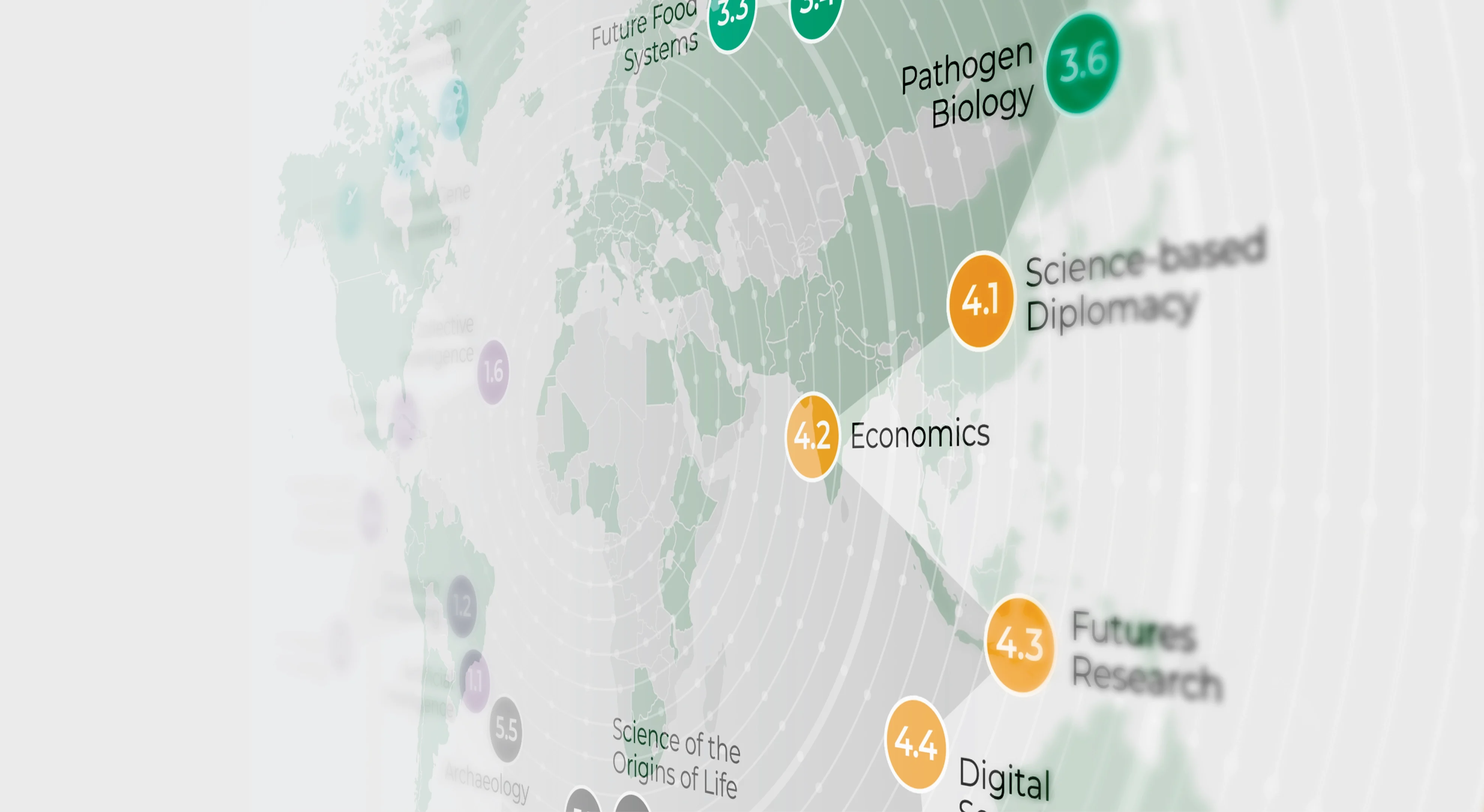
The Science Breakthrough Radar is composed of five platforms:
Within each broad area, the set of specific topics addressed by the Radar continually evolves and expands, adapting each year according to trends in science and research. These trends are identified by the GESDA Science Anticipation Team, through their broad academic training and continual first-hand engagement with the research community, in collaboration with GESDA’s Academic Forum. Each year, Michael Hengartner, Chair of the Academic Forum, presents the proposed list of topics for approval by representatives of the GESDA Board.
As GESDA’s academic network and science anticipation activities have expanded, so too has the scope of the Radar. The latest edition now features 29 points on the Radar, alongside an additional 10 topics explored through “Invited Contributions”. These shorter essay-style pieces are commissioned from domain-expert researchers when new emerging trends are identified outside of the Radar’s established focus areas, and often mature into points on the Radar in subsequent editions. As such, they represent a key mechanism through which expert insights continue to influence the evolution of the Radar’s topics.
GESDA Science Anticipation Activities
GESDA Anticipation Committees
The core of GESDA’s intelligence gathering happens via meetings of its topic-focused Anticipation Committees. These are chaired by a domain-expert researcher and comprise a diverse range of experts in the relevant field, based at different institutions and representing a wide range of perspectives at the forefront of their respective research domains. Together, the members of GESDA’s Anticipation Committees form its Academic Forum.
The GESDA Science Anticipation Team works closely with the Chair of each Anticipation Committee to define four sub-fields, or themes, within the field. These are the themes deemed most important to address through GESDA’s science anticipation methodology. The team then appoints the Committee according to these themes, aiming for a final committee of around 8 expert members in addition to the Chair.
In assembling the committee, GESDA’s team complements the Chair’s expertise and recommendations with a broad review of the scientific literature to establish the identities and locations of leading actors for each field. This ensures that the final committee reflects both the necessary breadth of expertise and appropriate diversity in terms of geography, demographics, and sectors represented.
Anticipation Committees meet at least once every two years during 2-4 hour online GESDA Anticipation Workshops.
GESDA Anticipation Workshops
The Anticipation Workshops are the cornerstone of GESDA’s methodology, representing the most regular and established mechanism through which anticipatory intelligence is gathered. These workshops, led by an academic Chair, convene leading experts in each field of interest to provide perspectives on anticipated developments in the four individual sub-fields over a 5, 10, and 25-year timeline.
Anticipation Workshops take place virtually and typically last for 2 hours, although a longer format of 3.5 hours has been trialled for certain topics this year, at the request of Chairs who felt more time was needed for discussion. During the meeting, the lead discussants for each theme are invited by the Chair to briefly present their perspectives at the start of each section, before the discussion is opened to all. These presentations, and the discussions that follow, are based on the following questions, which participants receive ahead of the meeting:
What key research opportunities and potential breakthroughs might lie ahead within your field?
What theoretical and practical challenges need to be overcome in order for these opportunities or breakthroughs to be realised?
When might these challenges be overcome, and how could this influence the field over the next 5, 10 and 25 years?
Importantly, GESDA is not looking for these discussions to provide a consensus view on the most likely future. Indeed, their purpose is to explicitly set out the range of potential futures for a particular field, working from the standpoint of what is known and aspired to by researchers in the current moment.
The meetings take place under the Chatham House Rule, meaning that no quote is attributed to a particular individual, encouraging an open and frank conversation between research peers. GESDA’s team of scientific writers synthesise the outcomes into the Science Anticipatory Briefs that make up the main body of the Radar. All participants are invited to review and edit these Briefs before final sign-off by the Chair, ready for open-access publication in the next edition of the Radar.
GESDA High Level Anticipation Meetings
In order to explore broader themes that transcend individual topics, GESDA convenes each year a small number of multidisciplinary, multi‑day “GESDA Anticipation Meetings” both within Switzerland and in diverse international locations. During these meetings, 20-30 leading researchers from intersecting fields come together to explore an emerging scientific theme based on one of the five Radar Platforms.
Much broader in scope than Anticipation Workshops, GESDA’s Anticipation Meetings are designed to provide a unique space of convergence for leading experts in distinct but related fields. The meetings explore emerging overarching themes and create corresponding novel conceptual frameworks – crafted for interdisciplinary tractability and strong actionability – within which to anticipate, accelerate and ultimately translate future science and technological advances into action and initiatives. Example frameworks from previous meetings include “Eco-augmentation”, defined as “humans’ deliberate and strategic interactions with nature for more resilient and sustainable social-ecological systems”, and “Planetarised Humanity” which captures “changes in the human relational condition that are induced by accelerating socio‑economic and technological co-evolution”.
During the three-day meetings, these overarching concepts are broken down into interconnected sub-themes for in-depth discussion and exploration. The programme typically combines higher-level keynote talks with more focused thematic sessions where short presentations frame anticipatory discussions aimed at identifying key developments over 5, 10, and 25-year horizons. While this anticipatory exercise mirrors the work of Anticipation Workshops, by framing these discussions within novel interdisciplinary concepts these meetings serve as a catalyst for field-building and fostering new research communities around emerging concepts. They have also frequently provided the starting point for pathways toward concrete action and novel global initiatives.
In the shorter-term, the output from these meetings takes the form of an open access “Deep Dive” or meeting report, which is made available through the Radar platform. This drives discussions between different sectors including researchers, diplomats, policy makers, the private sector, philanthropy and civil society during the GESDA Science and Diplomacy Summit, held annually in Geneva.
Invited contributions
Invited Contributions provide a way to capture and share the perspectives of domain-expert researchers on topics not otherwise covered in the Radar, or on complementary areas closely related to existing topics. When a notable gap or area of interest is recognised, the GESDA Science Anticipation Team will invite an appropriate leading researcher, or group of researchers, to explore the topic in a shorter essay-style perspective. Importantly, while these pieces do not feature explicit time horizons such as those found in the Anticipatory Briefs, they explore emerging trajectories and their implications, in keeping with the Radar’s anticipatory outlook.
Lenses
GESDA’s Science Anticipation Lenses are substantial pieces of novel academic research that build on the insights of the Radar. They provide a transversal perspective across its horizons, examining some of the fundamental questions raised by anticipated breakthroughs within broader scientific, philosophical, or geopolitical frameworks. These detailed reports are often developed by research groups rather than individual scholars, and in some cases are commissioned directly by GESDA.
Anticipation Potential
In addition to the qualitative data obtained from Anticipation Workshops and Meetings, each topic in the Radar is assigned an “anticipation potential” score by researchers working in this area.
The anticipation potential is a numerical readout developed by GESDA to facilitate appreciation of future-focused aspects of the scientific emerging topics discussed in the Radar. Specifically, it captures the capacity for impactful action in the present, considering the topic’s possible transformative breakthroughs in the future. It is derived from survey responses from scientists in relevant fields around the world, and as such reflects the science-informed perspective of the research community, prior to any engagement with diplomatic or other communities.
This numerical score defines where a topic “dot” sits on the Radar radial graph, or “star”. The higher the score, the greater the capacity for impactful action in the present, and the further the dot sits from the centre of the graph.
The survey that gathers this data is sent out to members of the international research community, including (but extending far beyond) members of GESDA’s Anticipation Workshops.
The survey is made up of six questions. The numerical outputs, where the highest score of 5 indicates the highest need to anticipate, serve to quantify the following three, equally weighted, and interconnected dimensions:
- The uncertainty of future science breakthroughs in a research field over the next 25 years. This is defined and measured by:
a) Time to maturity: how far away in time are anticipated impactful breakthroughs?
b) Confidence: how defined and certain are research trajectories leading to those breakthroughs?
Greater uncertainty, reflected by longer timeframes and lower confidence in the direction of research, translate to enhanced opportunity for action and therefore greater anticipation potential.
- The transformative nature of those breakthroughs for research and for society. This is defined and measured through these questions:
a) What is the transformative power of future breakthroughs for science and technology (research)?
b) What is the transformative power of future breakthroughs for society?
Greater transformative power translates to greater anticipation potential.
- The scope for action in the present to ensure that the potential from these breakthroughs is realised. This is defined and measured by:
a) Awareness: what is the level of awareness of potential transformative effects of future breakthroughs?
b) Opportunity: how much scope is there for international coordinated action to realise opportunities made possible by future breakthroughs?
The final anticipation potential scores are derived from the responses to these questions. Greater scope for action, as defined by low awareness and more room for multilateral action, translates to greater anticipation potential.

Breakdown of the 3 equally-weighted components, and their sub-factors, that together define anticipation potential.
Survey participants answer the same questions for each of the four sub-topics, and the four resulting anticipation potential scores are averaged to make up the final score depicted on the Radar graphic.
Anticipation potential scores for individual sub-topics are also displayed in the Radar, in diagrams on the introduction page to each topic. The breakdown of individual sub-topic scores, according to the 3 components and 6 survey questions, can be found in radial graphs on each sub-topic page.
Finally, the survey includes one additional question on Anticipatory Impact, at the level of the overarching topic. This asks participants to score to what extent they think future research in this area will impact a) who we are as humans, b) how we live together in societies and c) our relationship to our planet (GESDA’s three overarching questions). The results from this question are depicted in a radial graph located on the introduction page to each topic.