
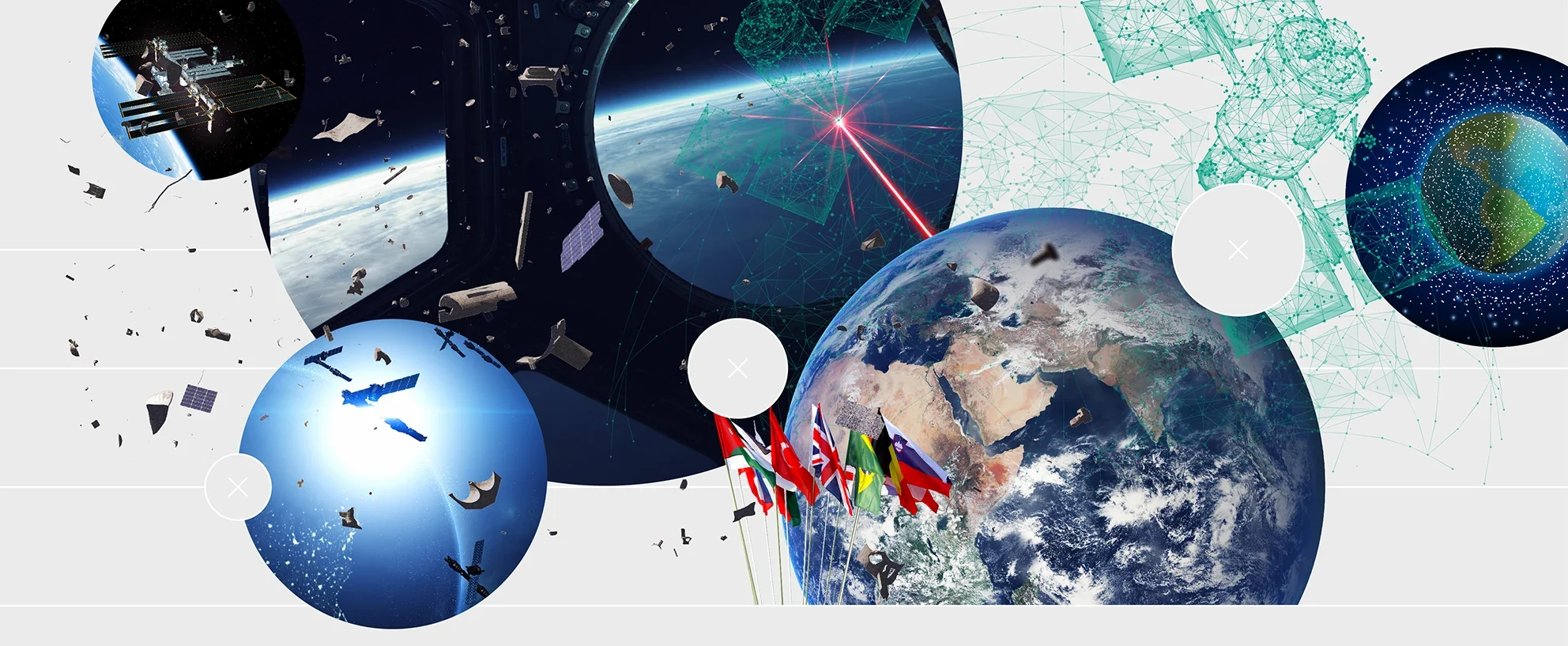

On the one hand, outer space could be thought of as an environment like any other, with attendant practical questions about ownership, rights and occupation. Should the mineral resources of the Moon become the property of whoever gets to them first? Or should they be stewarded carefully for the benefit of humanity – or remain untouched to preserve the wilderness? Factories in space could produce medicines, semiconductors, and other materials with properties we cannot achieve on Earth, but how do we ensure that they are operated and decommissioned responsibly, rather than becoming space junk – and who’s responsible for tidying up the worrying amount of junk that’s already in orbit, to allow safe operation of orbital facilities and facilitate new ventures? And we might one day set up outposts or even settlements on other worlds: but how would they be governed, and by whom? Should they be free to experiment with new socio-economic and political models, or should they be bound by extensions of terrestrial laws – and how could such laws possibly be enforced anyway?
On the other hand, outer space is profoundly different from anywhere we ordinarily experience, and as such it cannot be readily placed within the social, environmental, political and legal contexts applicable on Earth. There can be significant incentives to skip the conceptual stage – the engineering case for solar power stations and data centres in space, for example, appears attractive enough to draw substantial investor attention – but the implications of putting such complex and critical infrastructure into orbit have barely been examined. Addressing this conceptual deficit requires interdisciplinary conversations that bridge science, technology, design and the humanities – philosophy, history, political theory, archaeology, anthropology and art, among others – to create a comprehensive blueprint, or roadmap, that is effective, practical, just and sustainable.
Spheres of influence
Space has come to be seen as overtly separate from Earth, and vice versa. This is a historically atypical view of things which has emerged over the past two centuries as a result of a decreasing dependence upon the night sky for navigation, agriculture and culturally significant storytelling. In some respects, early astronautical exploration actually heightened this perception; artefacts like the famous “Earthrise” photograph taken from Apollo 8 led to conceptions like “Spaceship Earth”, in which our planet is viewed as closed system containing all the ingredients needed for life except energy from the sun – much as a terrarium can be constructed which requires only light to maintain its miniature ecosystem.
One common understanding of this boundedness is that humans leave the planet when we go beyond the atmosphere. Drawing upon terminology from Vernadsky, this marks the outer limit of the biosphere – the zone within which terrestrial organisms can survive unaided, with the possible exception of a few hardy microbes. But this is only one of the Earth’s conceivable spheres of influence. There is a considerable volume beyond the atmosphere whose conditions are dictated by the Earth’s gravitational and magnetic fields, which are relevant to both life on earth – since they inform vulnerability to such hazards as asteroids and solar radiation – and to human exploration, since they dictate how efficiently and safely our vessels can travel.
Seen through the lens of political theory, this portion of space, which extends beyond the Moon’s orbit, can be thought of as part of the Earth system and can be conceptualised as the astrosphere. The astrosphere can be thought of as another outer layer of Earth, or as the “outer space” part of the Earth-Moon system, not something lying beyond it. It should be distinguished from outer space more generally, which can be characterised in terms of far larger spheres of influence, beginning with that of our sun. Conditions in these larger spheres are radically different from those in our astronomical neighbourhood with regard to distance, interaction, interdependence and the prospects for degradation and crowding, and most of the considerations that apply to the astrosphere are irrelevant to them on any foreseeable timescale.
The astrosphere provides an interesting complement to the lithosphere, mantle and core of the Earth, which are similarly inhospitable to life, but also exert an influence over the biosphere and human activity through geological processes and seismic activity. In both cases, the expanding scope of human activity is changing our understanding of these spheres of influence. Since they can be accessed only through highly technologized means, another useful concept for making sense of this new spatial reach is the technosphere, the system comprising all objects manufactured by humans, which is calculated to weigh some 30 trillion tons and now extends far beyond the surface of the Earth – giving humans agency in places to which humans have not travelled and perhaps cannot travel. Human activity is extending the biosphere and technosphere far beyond the atmosphere, undermining its status as a planetary boundary.
In fact, the Earth has historically an open system. Meteorite falls, once considered vanishingly rare, turn out to be only the edge cases of a continual infall of cosmic material; they may have delivered many critical ingredients to early Earth, including organic molecules and water. Now, a return to openness is being shaped anthropogenically, with earnest discussion of rare earths or scarce gases being extracted from celestial bodies for use on Earth. Conversely, there is also potential to send material into space: most obviously, the craft and machines needed for exploration and extraction, along with their crews and cargoes; but also materials like nuclear waste, which we would rather not store on “Spaceship Earth”. In this framing, we can avoid environmental ruin by removing undesirable elements and replenishing beneficial ones, much as a terrarium benefits from being refreshed when it teeters too far out of ecological balance.
This new sense that the Earth’s atmosphere is permeable, rather than a fixed boundary, may gradually be leading to an enlarged sense of belonging — a sense of who we are that extends beyond the planet – perhaps reaching lunar orbit, which is far as humans have yet ventured, or perhaps to the asteroid belt, the furthest remove at which humans have credible ambitions. This expanded sense of being is significant inasmuch as it provides the foundation for environmental awareness in space. It is one thing to regard the Moon or asteroids as a quarry; it is another to regard them as a distant part of the place to which we belong: part of our home, and therefore deserving of protection.
Geocentricity and the environment
If space, and the bodies in it, are deserving of environmental protections, what forms should these take? Much of the high-profile conversation to date has revolved around the legal and political frameworks that might shape answers to this question, often by analogy to other ambiguous zones. John F Kennedy spoke of “this new ocean” in launching Apollo, invoking historical associations with navigation, exploration, discovery and colonisation. The suggestion is of uncharted expanses and limitless bounty – but as we have learned, the possibilities are more constrained than the metaphor suggests, and human capacity to compromise them more extensive. The same is true for space, but likely to play out in very different ways.
Between 1950 and around 2020, some 8,000 satellites were put into orbit, of which fewer than a thousand are still operational but roughly half are still in orbit. Some are intact and stable (for now); but others are drifting, some are breaking up. The more time goes on, the greater the chance that one will collide with another piece of orbital equipment, alive or dead, leading to a huge increase in orbital debris. That increase will itself increase the likelihood of further collisions, potentially leading to a runaway “Kessler effect” which ends up with some orbital sectors becoming unusable. This is not a situation which has any parallel with the ocean: since 1500, some 1.2 million ocean-going vessels have been built. The vast majority of these have either been decommissioned or destroyed: there is not a vast armada of ghost ships wandering the high seas. A shipwreck does not generally make a waterway impossible to navigate. The problem of space junk is fundamentally different.
Now multiple actors are putting “constellations” of satellites into orbit – most obviously SpaceX, which is projected to launch 100,000 satellites by the early 2030s. These have a five-year lifespan, after which they will be deorbited or fall into the upper atmosphere, where they will burn up. What the residual soot will contain is somewhat unclear, because its composition is proprietary information. But even if the soot’s composition was known, we do not have the theoretical or experimental tools to assess its likely effects once deposited in the stratosphere. We know from experience with ozone-depleting chemicals, however, that the upper atmosphere can be highly sensitive to even small chemical changes.
So the environmental challenges that face us in space are distinct from those we have experienced previously. They are shaped by the characteristics of the environment, and how these constrain the interventions humans can make; they are also shaped by our motivations. Addressing them requires not just a new conceptualisation of space, but a novel perspective on Earth. Copernicus displaced Earth from the centre of the universe in 1543, but many disciplines remain effectively geocentric. We treat Earth as the only case rather than as one planet among many – among the rest of the solar system, and the 5,000 exoplanets already discovered. Centring Earth in this way privileges planets with life and devalues abiotic environments. Much of the discussion of governance of the oceans, for example, is motivated by the need to protect its biota – but we have not yet found any organisms to protect in outer space. In fact, the opposite is true: considerable “planetary protection” efforts have been made to prevent terrestrial organisms from infiltrating space (although this may well have already happened).
The focus of environmental concern in space, then, lies in the intersections of the technosphere, the biosphere and the astrosphere. The technosphere identifies the aggregate of human-manufactured objects as a planetary-scale system, comparable to the biosphere or hydrosphere in reach and interconnection. In these intersections, we are dealing with an entity created by the combined effects of human action and the natural environment, known in cultural heritage as a cultural landscape: an integrated object of management in which the natural and cultural remain analytically distinct but cannot be separated in practice.
Space archaeology and heritage proffers a sharp reframing here. Where archaeology investigates human interactions with material culture and the environment as evidence of past and present behaviour, space archaeology focuses on the extension of human material culture beyond Earth into the solar system, from terrestrial infrastructure to defunct satellites and other space junk, material deposited deliberately or accidentally on planetary and lunar surfaces, and deep space probes. Within this field, taphonomy – the study of how human materials decay – shows where the nature/culture distinction breaks down altogether.
Consider interplanetary dust: we now have dust from human spacecraft mingling with it, and at this level, depending on the kind of instrument we are looking with, nature and culture are virtually indistinguishable. You cannot simply remove space junk from Earth orbit and expect a return to pristine state; you have to manage the relationships that constitute the new entity. We could instead think of the satellite constellations and proposed data centres as the first steps towards a Matrioshka brain, the orbital-scale supercomputing megastructure proposed by Robert Bradbury in the 1980s.
Heritage, specifically, is what we wish to preserve from the past for the present and future, and it includes both tangible and intangible elements. However, one generation’s junk is another generation’s heritage. Space junk is generally characterised as rubbish interfering with the orbital environment. But this is in part because of its inaccessibility and the risks it poses to infrastructure and commercial activity. If we could study it in situ, we would: abandoned satellites may be defunct but still hold historic, scientific, aesthetic, social, and spiritual significance for communities on Earth. That significance can have political implications: for example, the US flag at the Apollo 11 site can be read as an abiding assertion of national glory. Recognising this gives us new ways to consider managing this material: we could instead look for ways to build connections to all terrestrial communities, so that space really is for everyone, as the Outer Space Treaty claims.
Universalism is also significant in terms of some other challenges, such as mining on the Moon. Such mining might or might not be evident from Earth, but a “gold rush” might well mean the loss of the Moon as a cultural resource for all humanity through some repetition of the problems associated with nationalism, capitalism, extractivism, and colonialism. This has already happened with the night sky, whose full spectacle is increasingly elusive, due to light and air pollution, aircraft and satellite lighting and nocturnal human activity. If we wish to avoid a similar scenario unfolding with the Moon, we will need to interrogate how engagement with the Moon enriches what it means to be human, and more-than-human. The Moon becomes a co-participant in a two-way interaction: we ask what it needs from us to survive, rather than what we can extract from it.
Such questions go far beyond the those usually framed in environmental impact assessments (EIAs), which many have urged to be adopted for space. An effective framework would require three prior recognitions: that space is itself an environment; that abiotic environments can have intrinsic or relational value; and that cultural heritage management belongs inside the EIA process, not alongside it. Such EIAs would have to cover all phases of a mission: manufacture, launch, transit through Earth orbit, mission location, and end-of-life.
And the response needs to encompass benefits for everyone. If space is the common heritage of all humanity, then all humans are stakeholders — especially since modern society can no longer function without space-based assets. This cannot be left to aerospace corporations and so-called space-faring nations: the opinions of all eight billion people on Earth matter. How can we involve them in decisions about space in ways that enhance rather than diminish their existence?
This calls for new methods of gathering and acting on opinion at the global scale. We have already seen that space missions can capture imaginations across national borders and cultural differences; space heritage is important here because it keeps people connected to places, and these attachments — stories, emotions — transform space from an empty vacuum full of abiotic rocks into a vibrant system in dynamic interchange with the cosmos. But space exploration is not confined to the past, of course: we need also to look to the future.
Exploration and expansionism
Human occupation of space, and celestial bodies, is finally becoming a realistic possibility after centuries of imaginary journeys. The current trajectory seems to recapitulate previous experience: just as the 20th century saw a geopolitical Space Race between the United States and the Soviet Union, many of those issues are now being reproduced or replicated in the 21st century, at a moment when the world is more fractured than at any time since the Cold War. The postwar aspiration of UN-style global consensus is no longer realistic, and a successor to the Outer Space Treaty would be extremely difficult to secure.
The tenor of the moment is for unilateral actions, bilateral deals and multilateral agreements. Luxembourg, for example, initiated an ambitious bid to become a global centre of space commercialisation by passing a 2017 law recognising property rights in the astrosphere. Many space-faring nations have signed the Artemis Accords, drafted by NASA and the US State Department – but not the US’ key geopolitical sparring partners, including Russia and China. There is a push to build the first lunar base by the beginning of next decade, and an active competition between the US and China over who will establish the first human settlement, research station, or infrastructure on the Moon. The saying “as above, so below” applies to the astrosphere.
However, this century has also seen the emergence of what is called New Space: the private sector, venture capital, and a range of very powerful companies — SpaceX, Blue Origin and others — that are not only building new technologies but also developing new ideas about how we might live in space. There is a notion of a ladder of steps — large infrastructures, the Moon, asteroid resources, colonisation — that will take us outward, as made familiar by decades of science fiction.
Such space expansionism is widely endorsed by the New Space fraternity, who argue that we must become a multi-planetary species to avoid a terrestrial catastrophe from wiping out humanity – a position most prominently espoused by Elon Musk. A related but softer position is that space holds the answers to Earthly challenges like resource depletion, power generation and waste disposal. This hegemonic narrative, pushed top-down, often by private companies directly involved in the development of space technologies, has the potential to drown out discussion of other ways of engaging with outer space.
This is not to suggest that control over space technologies will translate straightforwardly into the realisation of such aspirations. Space technologies are subject to numerous constraining factors, need to work in demanding and unfamiliar environments, and are combined into massively complex systems. The Space Shuttle, with its two major disasters, may now seem a distant memory, but it illustrates the limits of predictability and control. With more than 2.5 million parts, nobody could hope to have knowledge of all the Shuttle’s low-level systems or how they might behave in all conditions. The operating landscape of New Space is no less demanding – particularly since acute commercial considerations have been added to the mix.
From this milieu emerges an evolving complex of space-related fears. Some are contemporary and technologized: anxieties about elites abandoning Earth, looking to escape to off-world utopias while leaving Earthly environments and societies to further degrade. Others are ancient and primal. The Cosmic Hunt tale, an ancient story told in many versions around the world, is an anxiety about space; the Sami version warns that if the hunting goes badly in the skies, the sky itself will collapse on you. This is reflected in anxieties about Earth-crossing asteroids or orbital disasters. So we have both shallow fears, linked to the track record of the space sector, and historically deep ontological fears.
Marginal in modern politics until recently, these fears are now moving towards the centre, and space may become a much more prominent focal point for political dissent, building on well-established scepticism about the value of exploring space. Such scepticism is now active within some political movements – consider the “no Planet B” slogan favoured by some environmentalists – and strengthened by “ground bias”, the tendency to over-separate Earth and space, and thus to overlook or disbelieve that astrospheric interventions can offer insight and solutions to terrestrial problems. This is despite the previously demonstrated benefits, including communications, Earth-sensing and navigational infrastructure and the recognition of a runaway greenhouse effect on Venus, with its implications for Earthly climate change.
There are potential alternatives to both unbridled expansionism and sceptical rejection. The way we are anticipating the move to outer space through current missions has already given us a kind of social and cultural prototype: the International Space Station (ISS) has been a model for how we may one day inhabit the Moon, and Mars beyond. Many researchers, documentarians and artists have described the new forms of sociality and subjectivity that emerge when humans cooperate and live together in outer space, and in experimental habitats on Earth that serve as analogues for deep-space missions. Antarctic stations and deliberately isolated biodomes have served this role for decades: places where researchers have lived, worked, and formed communities in extreme conditions, and where anthropologists have studied how humans construct meaningful lives in environments not originally intended for them. When extended to the astrosphere, these observations are of practical as well as conceptual relevance, since the success of future missions may depend on understanding human behaviour under such constraints.
These models provide some empirical grounding for future space exploration, but how they might scale up to larger and more enduring efforts remains conceptually murky. From a philosophical perspective on the cosmic commons, we might ask what happens to the classic value concepts that underpin liberal democracy – liberty, equality, fraternity – when carried into the astrosphere. The claim is not that they no longer matter, but that our inherited political vocabulary may be losing its grip. Liberty is obviously constrained in multiple ways. You cannot live in space as you do on Earth, so entirely unrestricted freedom is not possible in relation to places like the Moon or Mars. Surviving there at all requires enormous resources and expertise – which until recently, would have been unequivocally reserved to superpower nation-states but is now also claimed by plutocratic corporations. Whether such claims will pan out remains to be seen, but on any foreseeable timescale, the potential residents of space will be completely dependent on some national or corporate power for the basic requirements of existence: air, water, food, shelter. Liberty in the fullest sense of the terrestrial tradition is certainly not what awaits humanity in space.
Similarly, equality translates poorly to space. There is no notion that the US, the UK, the Europeans, and Japan are equal partners with each other or with aspiring space-faring nations. Inclusion – participation without equality – may be the closest we can come, in the same way that space missions today facilitate participation by nations and groups who do not have space-faring capabilities themselves. Fraternity, or community, is where the strongest continuity holds: it carries planetary environmental protection, integrity, sustainability, flourishing, justice, risk, and belonging into the astrosphere with something like their terrestrial force intact. Two out of three of our founding political concepts, then, do not travel. That is a substantial loss to reckon with, and a reason to be sceptical of any framing that treats space as simply an extension of Earth’s political geography.
Inclusion and community could be enhanced by the enlarged sense of being referred to above, and the question is then how these could best be fostered. In this respect, the balance of humans and automation is key. Robotics and telepresence mean that there may be little practical need for humans to physically visit remote parts of the astrosphere (or beyond). Sending humans to the outer planets, for example, would be physically and psychologically arduous to the point of impossibility, and many scientific and commercial objectives can be achieved more expediently through automation. Such arguments are one plank of space scepticism: communications satellites are not crewed, and orbital data centres might not be either. But in some cases, the societal need may be better served if humans do make the journey, since it is likely that the experience of humans standing on (say) the Martian surface, will feed back and enrich human culture in ways that even the most imaginative fictional experiences or immersive automated missions cannot.
Settlement and society
What kind of society and culture are we going to build in outer space? While the astrosphere is much larger in terms of volume than the other spheres of Earth, it is in a sense more compact, because travel times within the astrosphere are much shorter. Even reaching the astrosphere requires a vehicle to travel far faster than any aircraft, which means the quickest pathway between any two distant parts of terrestrial Earth runs through it. Once in orbit, this pace can be maintained more or less indefinitely: the ISS has been circling Earth, in just over 90 minutes, for more than a quarter of a century. Travel times are also shorter for information, which can be transmitted along lines of sight through a vacuum rather than along lossy and circuitous physical connections.
These facts have led to the development, on the one hand, of intercontinental ballistic missiles and spy satellites; and on the other, of geosynchronous communications satellites and global positioning systems. Many possible interventions are intrinsically dual-purpose: for example, the runaway proliferation of space junk is a hazard to be avoided, but also potentially an offensive weapon that could be used to disable, destroy or deny access to adversaries’ orbital infrastructure. Planetary defence aims to build the capability to divert asteroids that might strike the Earth – but that capability to equally well be used to direct an asteroid towards a city as away from one, or to move it to a more advantageous location for mining, perhaps one sequestered from rival powers.
So space activity has so far altered the relationship between parts of the surface of Earth more than the relationship between Earth and other bodies in the cosmos. And any space programme in the foreseeable future, whether directed by government or private interests, will ultimately be motivated by the wants and needs of those on Earth. So far, this has been strongly shaped by the historical grounding of space exploration in great-power conflict, and particularly the close and continuing relationship between civilian and military purposes in space.
Given this, it is perhaps unsurprising that we reach for familiar metaphors and historical concepts, notably drawn from the dyad of capitalism and colonialism. Popular discourse speaks of alien-“hunting”, off-world “settlements” and space “mining” – but such concepts may have limited application in space. Talking of colonialism – perhaps to dispute proposed initiatives – makes sense for ground-based infrastructure in remote and Indigenous areas. It is less meaningful in space itself, where there are currently no peoples who can be displaced, or whose resources can be expropriated. Capitalism, as Adam Smith described it, may not be a continuity in large-scale space economies, where markets may not function efficiently and operational realities may squeeze out competition.
Such familiar frames also fail to capture some of the practical differences in space. Gravity is the accepted and universal background of human behaviour on Earth: our lived experience is that things fall when released from a height, and stay where they are when left alone. This is no longer true in space. We might term some devices gravity-invariant – they function as designed regardless of environment. Toothbrushes are one such technology. But others rely implicitly or explicitly on a universally preferred direction. Gravity also provides a universal context for our intangible culture: spatial orientation, directional metaphors, everyday motion and physics. If we strip gravity out of human culture, what survives?
Similarly, the stereotypical figure of the astronaut has until recently been a young, ultra-fit and daring “alpha male”, again drawing on the military backgrounds of pioneering spacefarers. New Space has opened the way to a greater diversity of genders, ages and physiques: a difference that might be regarded as a limitation on Earth is not necessarily so in space; in fact, it may be an advantage. There is work suggesting that disabled bodies may actually be more efficient in low-gravity environments such as the ISS, while the biomedical consequences of protracted stays in space may also call for different physiologies to the fighter-pilot cliché.
There are, however, other frames within which we could consider appropriate and desirable activity in the astrosphere. For example, space heritage, astronautical testimony and extraterrestrial artefacts have played an important role in shaping cultural perceptions, particularly in terms of creating a “whole-Earth” identity to complement national and more granular identities. The oft-cited “Overview Effect”, in which seeing the Earth from space arouses a profound sense of holistic, global community, is one example of this. We might seek to build on this to create explicitly Earth-centred space programmes, to counter space scepticism and ground bias.
By contrast, planetarity, a concept introduced by Gayatri Spivak, suggests that the planet as a whole is unknowable: effectively the opposite of the Overview Effect, it posits that there is no united humanity, no single version of Earth and no species-wide experience of it. This addresses some of the deficiencies of other perspectives: for example, it engages with Indigenous storytelling and practices of relationality and reduces the problems of anthropocentrism and geocentricism. Acknowledging that the Earth is an integral part of the cosmos may even mean the very concept of “outer space” seem overly anthropocentric. Engagement with Indigenous traditions, and their view of space, may also give us radical chronological perspectives on what runs deep in our human engagement with space – for example, from the Cosmic Hunt or Australian “sky knowledge” going back tens of millennia.
To explore these and other frames, we need to seek new and diverse narratives for our potential future in space – ones that go beyond the hegemonic visions currently promoted as inevitable by the space-faring powers and seek to frame things otherwise. This also requires challenging the idea that space is a commons, accessible to “all” when in fact, it is realistically confined to blocs determined by particular countries and particular companies. Uncommoning requires accounting for the diversities, divergences, and disparities that are overlooked by casual formulations of “all” and ensuring genuine linguistic, social and cultural diversity in space programmes. If everyone speaks only English or Mandarin there will be little space for cultural innovation and narrative diversification.
This is where the anthropological perspective becomes most active. Rather than accepting a single, seemingly inevitable “tomorrow”, whether by defaulting to the simplest projections or accepting a vision imposed by fiat, it invites us to engage in tomorrowing: the practice and poetics of continually producing and exploring a plurality of futures in film, science fiction, design, architecture, and anthropological writing.1 Tomorrowing takes as its critical target the hegemonic tomorrows already on offer — humanity as a multi-planetary species, escape from a failing Earth, the ladder of steps that leads outward — and asks what other futures might be lived, imagined, or defended in their place.
However, this is a task to be done with a concern for depth and care in order to avoid reproducing transitory political critiques. Even ostensibly alternative futures can reproduce familiar patterns: for example, a popular alternative-history television series may imagine a first American lunar base which it names it after the first British settlement in the Americas. Or it might answer more to a desire to “correct” the past than to address possibilities for a flourishing future. Tomorrowing is what happens when we notice such gestures and start doing them differently. Only when we have unpacked and explored the full range of possibilities can we make truly informed decisions about how humanity’s engagement with outer space. 3
Salazar, J. F. (2017). Speculative fabulation: Researching worlds to come in Antarctica. In J. F. Salazar, S. Pink, A. Irving, & J. Sjöberg (Eds.), *Anthropologies and futures: Researching emerging and uncertain worlds* (pp. 151-170). Bloomsbury Academic