

Frédéric Herman
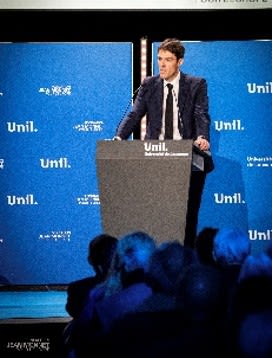
Frédéric Herman - Born in Belgium, I began my academic path in civil engineering at the University of Liège, followed by an Erasmus stay in Bristol that opened my scientific horizon and set me on a research driven career in Earth system dynamics. I pursued a PhD at the Australian National University, where I developed a strong foundation in quantitative geomorphology, focusing on glaciers, past glaciations, and the coupled feedbacks between climate and erosion. My work progressively shaped my long term interest in understanding how climate and landscapes co evolve. A postdoctoral position at Caltech further strengthened my international research profile.
In 2007, I joined ETH Zurich, where I consolidated my academic trajectory and expanded my research on mountain building, climate driven surface processes, and geodynamic–geomorphic interactions. By 2012, with growing international recognition, I chose to join the University of Lausanne (UNIL) to establish what would become the ICE (Interdisciplinary Centre for Earth Surface Dynamics) group.
At UNIL, I built ICE into a vibrant, internationally visible research team dedicated to understanding Earth surface processes across timescales, with strengths in geochronology, glaciology, climate–erosion feedbacks, and numerical modelling. Key PIs such as Georgina King and Guillaume Jouvet have been instrumental in shaping ICE’s interdisciplinary identity—combining cutting edge luminescence geochronology, advanced ice flow modelling, and quantitative tectonic–climate research. Together, we have positioned ICE as a leading European hub for process based, data driven, and model integrated Earth surface science.
In 2018, I became Dean of the Faculty of Geosciences and Environment, championing interdisciplinary thinking and collaboration. Since August 1, 2021, as Rector of UNIL, I have promoted a leadership approach grounded in dialogue, well being, and collective excellence. With my team, I continue to support high quality research and education, strengthen scientific careers, and advance UNIL’s expertise in environmental and digital transitions, equity, health, innovation, and open science, while sustaining strong European partnerships such as the CIVIS Alliance.