

Topic
Solar Radiation Modification
Solar Radiation Modification
Some options involve nothing more complicated than painting roofs white. Others entail constructing fleets of high-altitude aircraft for spraying reflective aerosols into the stratosphere or even space-based mirrors. The optimal solution may be one that deploys modification technologies alongside other climate responses such as emissions reduction and CO2 removal.2 Overall, there is growing scientific consensus that this approach would work in a technical sense, with some limitations.3 4
However, all SRM approaches raise challenging questions such as who should control the technologies, if and when they should be deployed and what should happen if a deployment goes wrong or fails entirely. Another concern is “moral hazard”: the possibility that investing in these SRM approaches would reduce the impetus to cut greenhouse gas emissions.
Given the increase in global mean temperatures, decisions about whether to research and deploy SRM are becoming increasingly urgent. However, there is a pressing need to develop international governance frameworks for deciding whether or not to conduct SRM field experiments and, if that decision is positive, how they should be conducted — and to prepare for making decisions whether or not to deploy at some point in the future.
Some governments and funding bodies are rising to the challenge, with the European Commission5 and White House Office of Science and Technology Policy6 both promoting further investigation and the UK starting a £10.5 million research programme.7 However, in March 2024, the field suffered a setback when the UN Environment Assembly failed to agree on the establishment of a scientific expert group to advise on SRM. The failure reflected concern in developing countries about the nature of the research and how the results would be used.8
KEY TAKEAWAYS
Reducing the amount of solar radiation incident upon Earth’s surface could help mitigate global warming, and strategies for reducing this radiation flux are under investigation. Stratospheric aerosol injection, which involves injecting chemicals into the lower stratosphere to reflect back some incoming sunlight, is promising, but raises a number of concerns. Cloud engineering schemes also show some promise but could lead to localised cooling and regional changes in precipitation pattern. Terrestrial solar radiation modification schemes to increase reflection of solar radiation back into space, such as painting more of Earth’s surface white, or artificially regrowing Arctic ice, are also under consideration. Further from possible implementation, but perhaps more impactful in the long term, are the Space-based solar radiation modification strategies such as radiation-reflecting satellites that carry panels to reflect solar radiation or shade portions of the Earth from the sun’s rays. All of these possible pathways require intense scrutiny and international cooperation if unintended adverse consequences are to be avoided.
Anticipatory Impact:
Three fundamental questions guide GESDA’s mission and drive its work: Who are we, as humans? How can we all live together? How can we ensure the well-being of humankind and the sustainable future of our planet? We asked researchers from the field to anticipate what impact future breakthroughs could have on each of these dimensions. This wheel summarises their opinions when considering each of these questions, with a higher score indicating high anticipated impact, and vice versa.
- Anticipated impact on who we are as humans
- Anticipated impact on how we will all live together
- Anticipated impact on the well-being of humankind and sustainable future of our planet

Stratospheric aerosol injection
Future Horizons:
5-yearhorizon
SAI conversations begin
10-yearhorizon
Modelling informs decision-making
25-yearhorizon
Governance of SAI deployment begins
There is evidence that SAI can offset some of the impacts of climate change, but will come with ancillary risks of its own. Crucially, it would be possible to restore the average global temperature to pre-industrial levels if sufficient quantities of aerosols were injected in a sustained fashion.9 However, modelling studies suggest that it is not possible to reset temperatures in every region. The same applies to precipitation, wind patterns and other aspects of climate. So, while SAI could lead to a more favourable outcome overall, there would inevitably be some winners and some losers.10
Sulphate aerosols are the most commonly proposed substance for SAI. However, sulphur’s potential to damage the ozone layer or lead to acid rain is a significant concern and this is driving research into alternative materials, such as calcites or chalk powder. A better understanding of the way all these materials interact with the upper atmosphere is much needed.
The overwhelming majority of studies of the effectiveness and consequences of SAI have been carried out through computer modelling. Most of the field tests that have been proposed have been called off after facing opposition.11 But a small number have taken place, carried out by independent researchers and funded by entrepreneurs, raising concern over the possibility of unilateral action.12 13
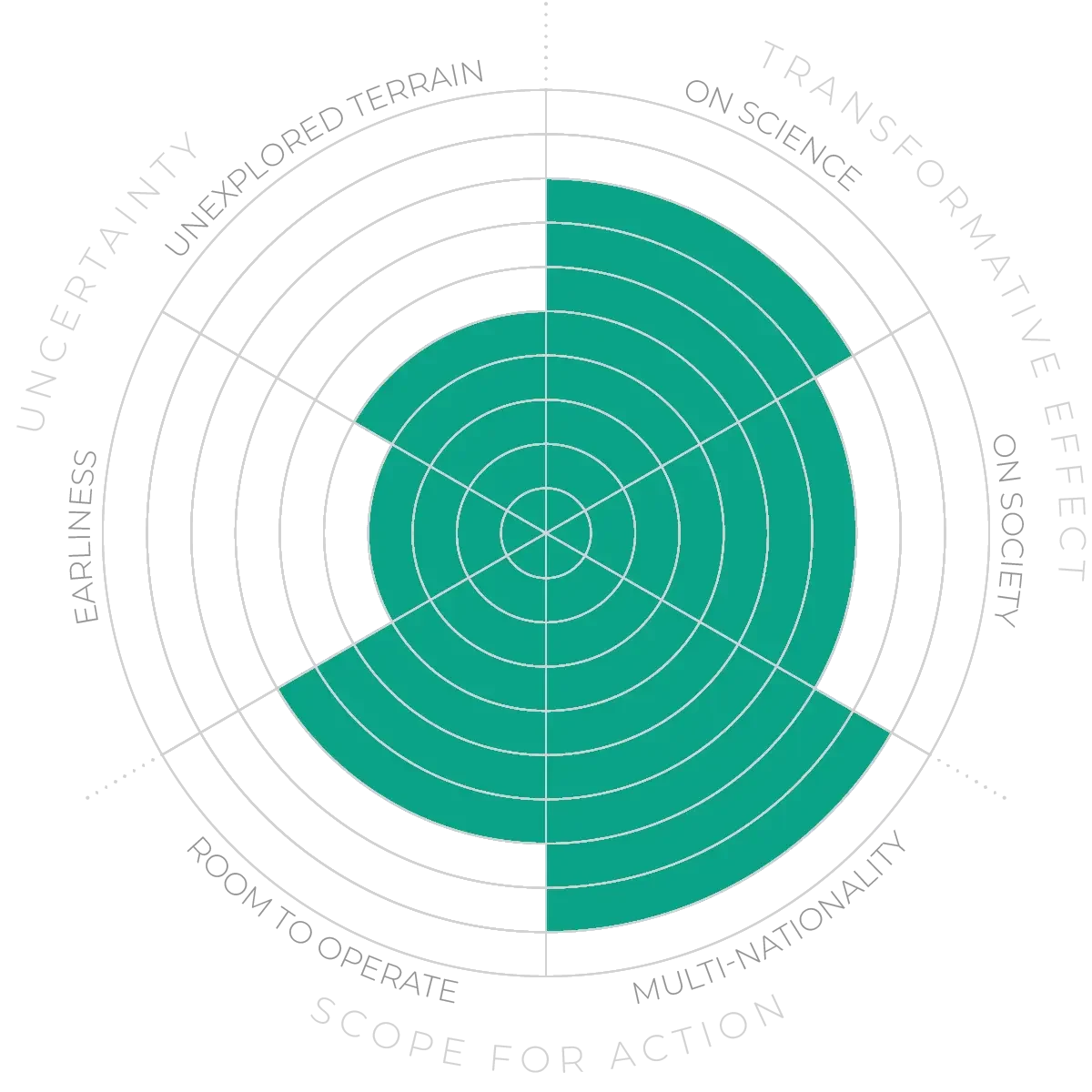
Stratospheric aerosol injection - Anticipation Scores
The Anticipation Potential of a research field is determined by the capacity for impactful action in the present, considering possible future transformative breakthroughs in a field over a 25-year outlook. A field with a high Anticipation Potential, therefore, combines the potential range of future transformative possibilities engendered by a research area with a wide field of opportunities for action in the present. We asked researchers in the field to anticipate:
- The uncertainty related to future science breakthroughs in the field
- The transformative effect anticipated breakthroughs may have on research and society
- The scope for action in the present in relation to anticipated breakthroughs.
This chart represents a summary of their responses to each of these elements, which when combined, provide the Anticipation Potential for the topic. See methodology for more information.
Cloud engineering
Future Horizons:
5-yearhorizon
MCB experiments are promising
10-yearhorizon
Small-scale MCB begins
25-yearhorizon
MCB in regular use
Various researchers have also proposed thinning and dispersing high-altitude cirrus clouds, which contribute to warming by trapping a disproportionately large amount of terrestrial radiation that would otherwise escape into space.16 Injecting these clouds with particles of bismuth tri-iodide allows the formation of large ice crystals within the clouds. These large ice crystals fall out more rapidly, shortening the clouds’ lifespan. Cirrus reduction can improve the transmission of long-wave terrestrial radiation into space.17
In February 2024, researchers at the US National Oceanic and Atmospheric Administration proposed injecting ice-nucleating particles into the troposphere to prevent water vapour reaching the stratosphere, where it usually absorbs outgoing radiation. This “intentional stratospheric dehydration” would help to cool the planet by increasing outbound radiation, although significant technical and practical hurdles would need to be overcome first.18
Whereas SAI has a globally uniform effect, cloud-engineering techniques produce more localised cooling, allowing them to be used in a targeted way. For instance, Australian MCB could be used to cool major coral reefs, which suffer bleaching when water temperatures become too high.19
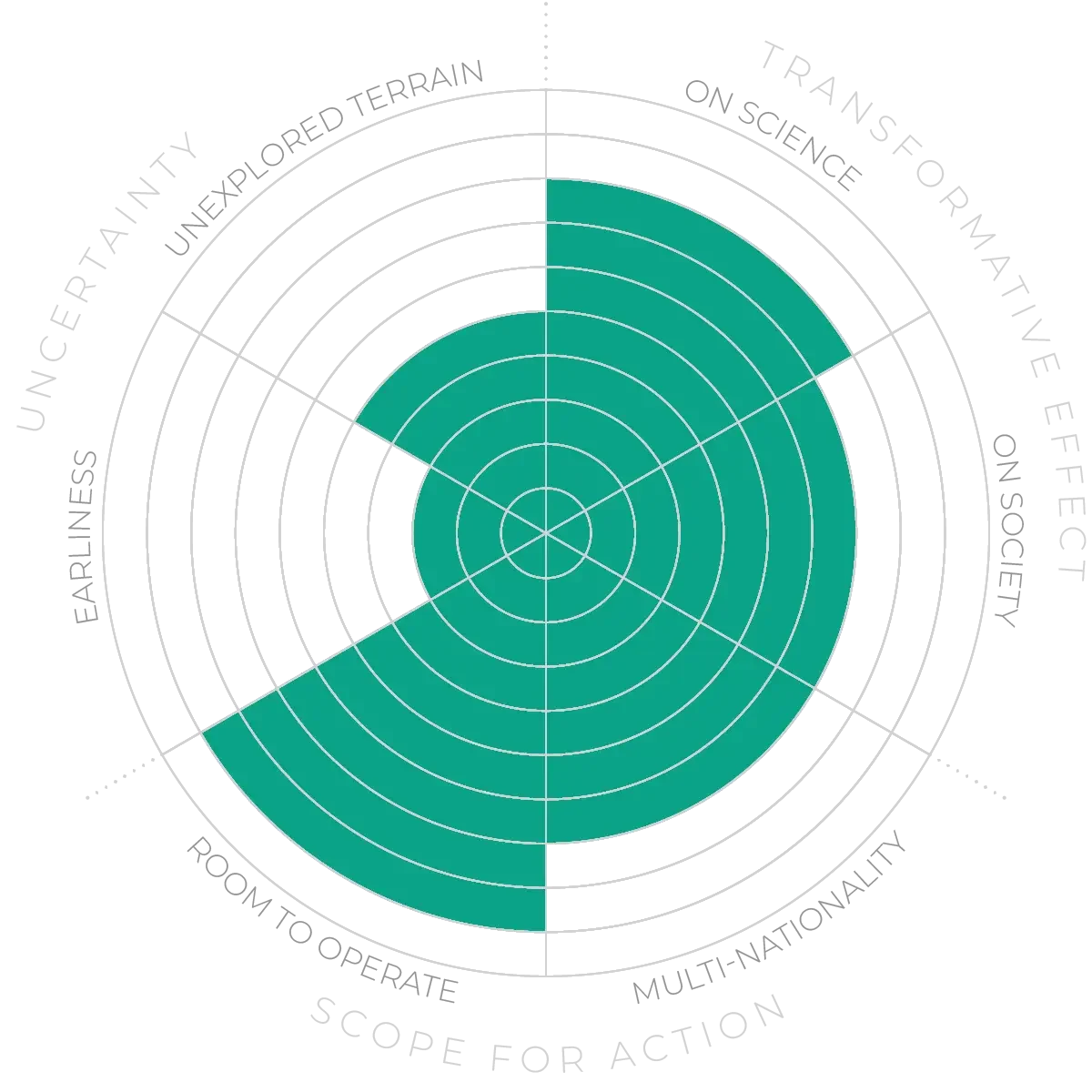
Cloud engineering - Anticipation Scores
The Anticipation Potential of a research field is determined by the capacity for impactful action in the present, considering possible future transformative breakthroughs in a field over a 25-year outlook. A field with a high Anticipation Potential, therefore, combines the potential range of future transformative possibilities engendered by a research area with a wide field of opportunities for action in the present. We asked researchers in the field to anticipate:
- The uncertainty related to future science breakthroughs in the field
- The transformative effect anticipated breakthroughs may have on research and society
- The scope for action in the present in relation to anticipated breakthroughs.
This chart represents a summary of their responses to each of these elements, which when combined, provide the Anticipation Potential for the topic. See methodology for more information.
Terrestrial solar radiation modification
Future Horizons:
5-yearhorizon
Urgency spurs international research
10-yearhorizon
Building codes embrace albedo brightening
25-yearhorizon
Crops assist albedo brightening
One prominent method is to paint roofs white or other pale colours. This can have direct benefits to the local populations, including mitigating the worst effects of heatwaves. Furthermore, the cost is relatively low.21
In areas not covered by buildings and roads, plants with light-coloured leaves can also change the local albedo. This is cited as a potential downside of planting additional trees on grassland areas: trees are typically darker than grass, so they lower the albedo and may thus contribute some warming. There is also ongoing research into engineering paler crop plants, a task in which synthetic biology may play a role.22
At the more extreme end of the scale, there are proposals to artificially regrow Arctic sea ice, perhaps by spraying tiny particles of silicon dioxide to encourage ice formation, or by pumping huge volumes of cold water up from the deep sea. In theory, schemes like these could restore a large area of reflective ice surface. However, the feasibility and costs are uncertain, and there may be unforeseen negative environmental consequences.23
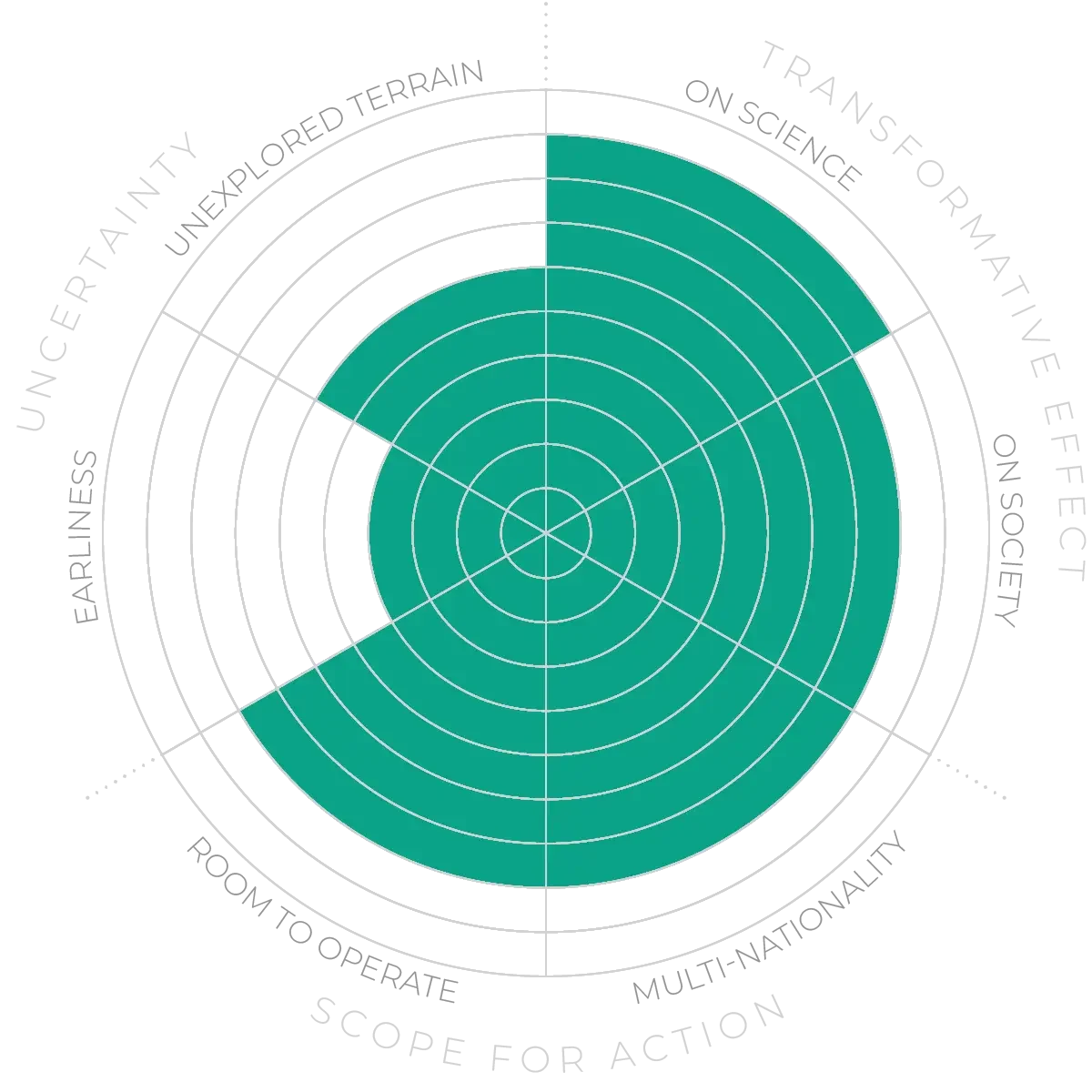
Terrestrial solar radiation modification - Anticipation Scores
The Anticipation Potential of a research field is determined by the capacity for impactful action in the present, considering possible future transformative breakthroughs in a field over a 25-year outlook. A field with a high Anticipation Potential, therefore, combines the potential range of future transformative possibilities engendered by a research area with a wide field of opportunities for action in the present. We asked researchers in the field to anticipate:
- The uncertainty related to future science breakthroughs in the field
- The transformative effect anticipated breakthroughs may have on research and society
- The scope for action in the present in relation to anticipated breakthroughs.
This chart represents a summary of their responses to each of these elements, which when combined, provide the Anticipation Potential for the topic. See methodology for more information.
Space-based solar radiation modification
Future Horizons:
5-yearhorizon
Space-based SRM remains a conversation topic
10-yearhorizon
Falling costs spur interest
25-yearhorizon
Feasibility studies begin
The simplest notion is a large occulting disc or “parasol”. This would be placed at a carefully chosen position between the Earth and the Sun, in order to produce a permanent partial solar eclipse. The ideal location would be Lagrange Point 1, where the gravitational pulls of the Sun and Earth are balanced.24
Researchers have also considered a number of alternative reflectors for reducing the radiation incident on Earth.25. These include Fresnel lenses, diffraction gratings and mirrors.26 27 The key considerations are the robustness of the design to meteoroids and other threats, and the mass of the structure — which must be carried into space by rocket, or else manufactured in space, adding to the cost.
All these technologies face considerable technical and economic barriers.28 For example, an occulting disc at Lagrange Point 1 would need to have a surface area of millions of square kilometres: no structure remotely close to such a scale has ever been constructed in space. Furthermore, such projects arguably also create a dangerous single point of failure in our climate-mitigation strategies: in contrast to Earth-based forms of SRM, the scale of investment and hardware deployment required for a space-based reflector would mean putting all our eggs in one basket, with catastrophic risks if the project failed.
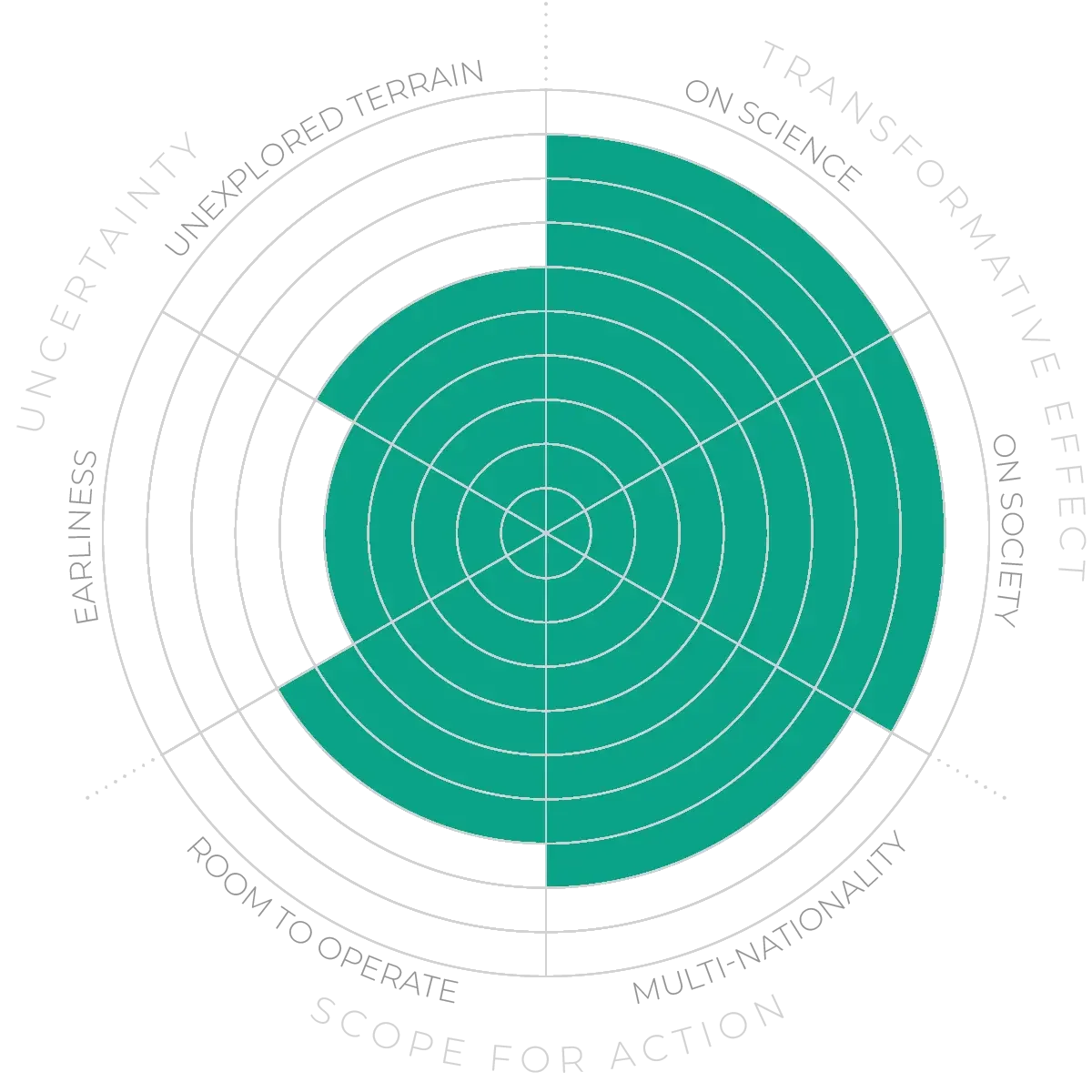
Space-based solar radiation modification - Anticipation Scores
The Anticipation Potential of a research field is determined by the capacity for impactful action in the present, considering possible future transformative breakthroughs in a field over a 25-year outlook. A field with a high Anticipation Potential, therefore, combines the potential range of future transformative possibilities engendered by a research area with a wide field of opportunities for action in the present. We asked researchers in the field to anticipate:
- The uncertainty related to future science breakthroughs in the field
- The transformative effect anticipated breakthroughs may have on research and society
- The scope for action in the present in relation to anticipated breakthroughs.
This chart represents a summary of their responses to each of these elements, which when combined, provide the Anticipation Potential for the topic. See methodology for more information.
Citations
Topic brief
- R. E. Dickinson. Climate engineering a review of aerosol approaches to changing the global energy balance https://doi.org/10.1007/BF00142576
- L. Cao. Simultaneous stabilization of global temperature and precipitation through cocktail geoengineering https://doi.org/10.1002/2017GL074281
- IPCC. Intergovernmental Panel on Climate Change https://www.c2g2.net/intergovernmental-panel-on-climate-change/
- B. Kravitz. Uncertainty and the basis for confidence in solar geoengineering research https://doi.org/10.1038/s43017-019-0004-7
- N. Academies. Engineering https://doi.org/10.17226/25762
- S. Talati. A New Era of Policy in Solar Geoengineering https://kleinmanenergy.upenn.edu/research/publications/a-new-era-of-policy-in-solar-geoengineering
- UKRI. Research Programme to Model Impact of Solar Radiation Management https://www.ukri.org/news/research-programme-to-model-impact-of-solar-radiation-management/
- R. Chaterjee. Solar Radiation Modification Resolution Withdrawn at UNEA-6 https://www.twn.my/title2/climate/info.service/2024/cc240302.htm
Stratospheric aerosol injection
- P. Irvine. Halving warming with idealized solar geoengineering moderates key climate hazards https://doi.org/10.1038/s41558-019-0398-8
- B. Kravitz. A multi-model assessment of regional climate disparities caused by solar geoengineering https://doi.org/10.1088/1748-9326/9/7/074013
- S. Osaka. Why a landmark experiment into dimming the sun got cancelled https://grist.org/science/who-gets-to-decide-if-we-study-solar-geoengineering-after-the-scopex-project-canceled/
- P. Voosen. Could Solar Geoengineering Cool the Planet? https://www.science.org/content/article/could-solar-geoengineering-cool-planet-u-s-gets-serious-about-finding-out
- J. Temple. Researchers Launched a Solar Geoengineering Test Flight in the UK Last Fall https://www.technologyreview.com/2023/03/01/1069283/researchers-launched-a-solar-geoengineering-test-flight-in-the-uk-last-fall
Cloud engineering
- G. Cooper. Preliminary results for salt aerosol production intended for marine cloud brightening using effervescent spray atomization https://doi.org/10.1098/rsta.2014.0055
- G. Cooper. A Review of Some Experimental Spray Methods for Marine Cloud Brightening http://dx.doi.org/10.4236/ijg.2013.41009
- D. L. Mitchell, W. Finnegan. Modification of cirrus clouds to reduce global warming https://doi.org/10.1088/1748-9326/4/4/045102
- L. Duan. Comparison of the fast and slow climate response to three radiation management geoengineering schemes https://doi.org/10.1029/2018JD029034
- J. P. Schwarz. Considering Intentional Stratospheric Dehydration for Climate Benefits https://www.science.org/doi/10.1126/sciadv.adk0593
- J. Latham. Can marine cloud brightening reduce coral bleaching? https://doi.org/10.1002/asl2.442
Terrestrial solar radiation modification
- S. I. Seneviratne. Land radiative management as contributor to regional-scale climate adaptation and mitigation https://doi.org/10.1038/s41561-017-0057-5
- K. W. Oleson. Effects of white roofs on urban temperature in a global climate model https://doi.org/10.1029/2009GL042194
- L. Genesio. Plants with less chlorophyll: A global change perspective https://doi.org/10.1111/gcb.15470
- K. Zimmer. The daring plan to save the Arctic ice with glass https://www.bbc.com/future/article/20200923-could-geoengineering-save-the-arctic-sea-ice
Space-based solar radiation modification
- J. T. Early. Space-based solar shield to offset greenhouse effect https://ui.adsabs.harvard.edu/abs/1989JBIS...42..567E/abstract
- R. Angel. Feasibility of cooling the Earth with a cloud of small spacecraft near the inner Lagrange point, L1 https://doi.org/10.1073/pnas.0608163103
- J. Sánchez. Optimal Sunshade Configurations for Space-Based Geoengineering near the Sun-Earth L1 Point https://doi.org/10.1371/journal.pone.0136648
- C. R. McInnes. Space-based geoengineering: Challenges and requirements https://doi.org/10.1243/09544062JMES1439
- C. M. Baum. Between the sun and us: Expert perceptions on the innovation, policy and deep uncertainties of space-based solar geoengineering https://doi.org/10.1016/j.rser.2022.112179