
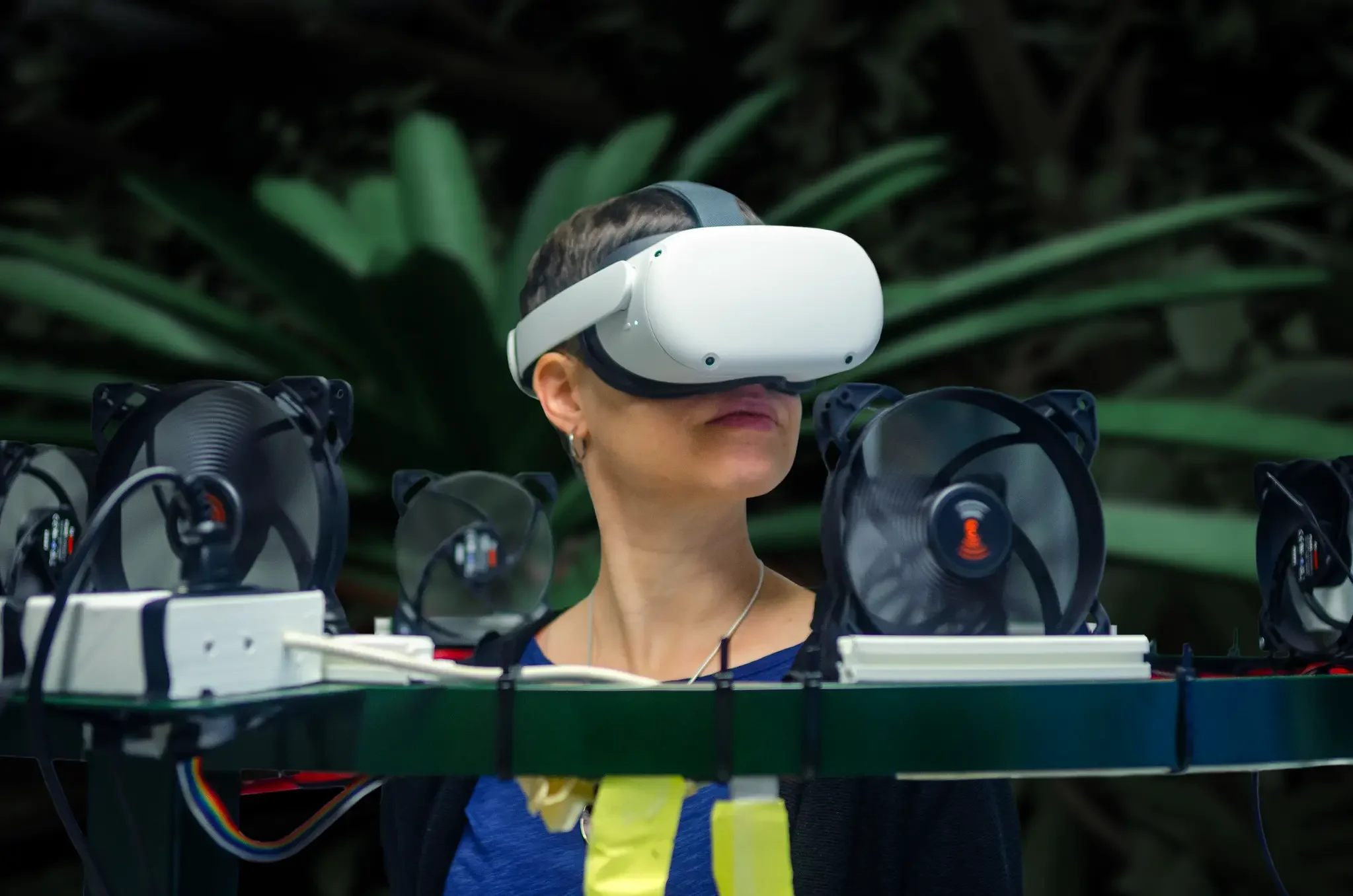
Topic
Extended Reality
Anticipation Committee Chair:

Karthik Ramani
Anticipation Committee:
Extended Reality
It encompasses several overlapping technologies. These include virtual-reality (VR) headsets that transport wearers to simulated worlds, “augmented reality” (AR) systems that overlay digital information onto a user’s view of the real world via a mobile app or smart glasses, and “mixed reality” (MR) devices that transpose interactive virtual elements into the user’s field of vision.1 Consumer headsets are already bringing VR entertainment to the masses, with more advanced offerings from providers such as Meta, Apple and Google also providing some MR functionality.2,3 Although prior investments were made by Microsoft and Apple, AR systems have seen limited uptake by the military and industry,4,5 while simpler AR smart glasses that look like regular eyewear are proving popular with consumers.6,7
Recent demos of advanced smart glasses by Meta and Google, which squeeze cutting-edge XR functionality into a sleek form factor, show the technology’s potential.8,9 However, these remain research prototypes, highlighting the field’s long-standing challenges with commercial viability. It seems the commercial players are looking to get feedback from users and also create ecosystems to develop applications for their devices, similar to what we have witnessed for smartphones. Creating capable, comfortable and reasonably priced XR hardware, along with the software and infrastructure to support widespread use, will require huge investment.10 So far companies have struggled to find mass-scale consumer use-cases that could justify the sums required.
However, advances in AI have given the field a boost. Breakthroughs in spatial computing, gesture recognition and language understanding, all of which are powered by AI, promise to boost the capabilities of XR devices. Simultaneously, AI developers are hunting for devices that can take full advantage of the technology’s rapidly improving visual and language skills — a new field called visual-language is developing very fast. Smart glasses not only allow the hands to be free but also view the world through the wearer’s eyes, opening up the prospect of an always-on AI assistant. Such an assistant will be able to seamlessly answer in any language users’ questions about the physical world the user is interacting with, while providing a personalised digital overlay of information in all modalities and 3D, dynamic, visual augmentations.
The blurring of the boundaries between the physical and digital worlds would entail and hold unknown and potentially enormous implications for society. However, achieving this vision will still require significant hardware advances to balance the competing pressures of performance, cost, and wearability.11,12 Significant advances also have to be made that make it easy to both author or create and use virtual content for XR devices.13 Meanwhile, developers will need to identify more targeted early use-cases to drive the investment needed to make fully fledged XR a consumer technology. Gaming, immersive and hands-on education,14 manufacturing,15 athletic coaching and spectatorship,16 and medical training17 appear to be promising options, each with its own unique contexts and challenges for uptake.
KEY TAKEAWAYS
Advances in display technology, wearable sensors, computer vision and AI mean that humans’ everyday experience of reality will increasingly become an integrated mix of inputs from the real world and digital sources. Continuing convergence of these technologies and breakthroughs in Spatial computing are making it possible for AI-powered XR devices to seamlessly merge complex virtual elements into the user’s view of the real world. Realistic immersive experiences will require systems able to truly understand and reason about their environment, and while these capabilities are rudimentary now they are improving fast. It will also be crucial to create intuitive XR interfaces that can dynamically adapt to the user’s needs. New control modalities and wearable sensors are making personalisation and adaptation increasingly possible, though context-aware XR systems remain some way off. Advances in AI, from three-dimensional computer vision to multimodal interfaces, are also opening up the prospect of populating XR environments with smart “agents” or creating intelligent and spatially aware digital assistants. Our understanding of Human-AI interaction in the spatial world remains rudimentary. These interactions also continue to improve with spatial computational technologies, devices and algorithms. Additionally, these possibilities raise a host of practical and ethical questions. While current commercial XR technology is primarily audio-visual, emerging Haptics and multisensory interfaces in research could soon add touch, taste and even smell to future virtual experiences. In the near term these could boost the realism of immersive experiences, but a more distant goal is to compose multisensory narratives that boost immersion.
Anticipatory Impact:
Spatial computing
Future Horizons:
5-yearhorizon
3D reconstruction and geometric reasoning progresses rapidly
In the near term, low-cost headsets become commercially viable at higher scale. Then the demand for better spatial-computing capabilities from a range of AI-application areas drives rapid progress in 3D reconstruction and geometric reasoning. This brings some high-value XR use cases, such as in manufacturing and production, into practical reach, making the field increasingly commercially attractive and spurring major new investments.
10-yearhorizon
XR goes mainstream
XR achieves mainstream adoption and becomes widely used in retail, education and healthcare. Highly realistic and physically accurate “digital twins” of real-world objects and locations become widely used by urban planners, engineers and manufacturers for real-time monitoring, design and process optimisation.
25-yearhorizon
Virtual and physical reality are intermeshed
Algorithmic advances now make it possible to use inexpensive cameras and motion sensors to simultaneously track a device’s location and map its surroundings.18 Advanced computer vision can also convert 2D images captured from moving cameras into detailed 3D models of spaces and objects19,20 and use them to reconstruct photorealistic 3D scenes from any point of view,21,22 enabling the virtualisation of entire environments. AI can also layer these 3D models with semantic labels that categorise objects and features within the environment,23 and seamlessly integrate virtual elements into scenes by allowing them to collide with or be occluded by real-world objects.24 Many of these capabilities are now integrated into freely available software development kits from large technology and gaming companies.25,26
However, developing a truly immersive XR experience will require AI models that can go beyond simply mapping and reconstructing 3D environments to understanding and reasoning about them. Fortunately, solving these problems will be crucial for a wide range of AI applications, including self-driving cars, robots and drones, so considerable resources are already going into this problem. Vision-language models trained on large amounts of image and text data appear capable of some degree of spatial reasoning.27,28 But “world models”, which learn rich representations of an environment’s spatial and physical properties to make predictions of how it will evolve over time, could be even more promising.29,30
XR interfaces
Future Horizons:
5-yearhorizon
XR experience becomes highly fluid and intuitive
10-yearhorizon
XR becomes globally available
25-yearhorizon
Users’ thoughts directly interface with XR
Many XR headsets today come with handheld controllers, but interaction is becoming increasingly multimodal. On many devices, camera-based gesture recognition and eye-tracking allow users to interact with virtual elements through simple hand movements or by using their visual focus as a cursor. Beyond providing more intuitive control options, the wide range of sensors embedded in leading XR devices can provide powerful insights into the user’s attention, intent and actions.
Machine-learning models can analyse eye-tracking data and ego-centric video captured by XR devices to infer what activity a user is engaged in33,34 or even to infer their intention to interact with both virtual and physical objects.35 Eye-tracking data can also provide a window into the user’s attention and level of engagement.36 When combined with basic physiological monitoring, it can also help to monitor the user’s cognitive load while carrying out tasks in XR.37
By combining these user-centric insights with spatial information, virtual elements and control interfaces can be adapted to the user’s immediate context in real time.38 This can be used to both improve the usability of virtual interfaces39 and overlay helpful information and control options onto real-world objects.40,41 It can even reduce the need for real-world physical interfaces, given the advances in “internet of things” connectivity between XR devices and the physical world. It can also make it possible for XR systems to detect when the user’s ability to interact with specific controls and interfaces is impaired by things like poor lighting, noise or multi-tasking, and adapt accordingly.42
Human-AI interaction
Future Horizons:
5-yearhorizon
AI agents become a common XR feature
10-yearhorizon
XR users enjoy an always-on virtual assistant
25-yearhorizon
Users’ everyday reality is powered by XR
The rapidly improving reasoning and decision-making capabilities of large language models now allow them to take control of simulated bodies in virtual environments to solve a variety of tasks.43,44 The ability of these embodied “agents” to communicate in natural language also enables them to collaborate with each other, as well as with humans, to tackle challenges.45 This is opening up the prospect of populating virtual environments with interactive AI characters for both entertainment and to act as digital co-workers.46 Integrating agents into XR devices and providing them with access to their suite of sensors could also enable always-on digital assistants that see the world through the user’s eyes.47
Considerable challenges remain. Even today’s most powerful models exhibit only limited embodied intelligence,48 and our understanding of how AI and humans interact remains rudimentary.49 Evidence suggests that creating useful digital assistants is challenging, and poorly designed AI can often hinder rather than help.50,51
Nonetheless, the possibility raises a host of practical and ethical questions. Should AI agents be embodied in human form, and how will their appearance and personality reinforce social biases? Will users control their own agents, or will they be services provided by companies? Should agents be able to augment how others perceive the user in virtual spaces, adjusting their appearance, movements and even speech? And if agents can digitally alter the user’s XR environment to boost immersion or enhance productivity, how do we ensure this doesn’t lead to deception or manipulation?52
Haptics and multisensory interfaces
Future Horizons:
5-yearhorizon
XR experiences are commonly multisensory
10-yearhorizon
Virtual and real experiences become increasingly similar
25-yearhorizon
Brain-computer interfaces evoke realistic multisensory experiences
A wide range of wearable haptic devices has been developed to simulate various tactile sensations such as pressure, texture and temperature.54 These include gloves, vests and bracelets that rely on a variety of approaches to generate tactile illusions such as vibrating electromechanical devices, electrical stimulation or shape-changing materials. These devices can be cumbersome, though, which is spurring growing interest in “mid-air haptics”, which uses ultrasound beams to stimulate the skin and generate highly modifiable tactile sensations without physical contact.55,56 Another emerging approach involves using mobile robots to simulate virtual objects57 or even reconfiguring physical environments to match the virtual one.58
Simulating the chemical senses of taste and smell is now becoming feasible. So-called gustatory interfaces are making it possible to recreate taste sensations in virtual experiences.59,60 Olfactory interfaces can be combined with software that is able to recreate how smells evolve over space and time.61,62
In the near term, haptic technology could play an important role enhancing the realism of mixed-reality training in fields like medicine.63 But in the future it could also make XR experiences more immersive and boost their emotional depth.64,65,66 However, this will require us to move away from using isolated haptic stimuli as an accessory to audio-visual experiences and instead work out how sequences of sensations can be combined to compose multisensory narratives.
Citations
Topic brief
- What's the difference between AR, VR and MR? https://forwork.meta.com/gb/blog/difference-between-vr-ar-and-mr/
- Apple Vision Pro https://www.apple.com/apple-vision-pro/
- Meta Quest 3 https://www.meta.com/in/quest/quest-3/
- Anduril and Microsoft partner to advance Integrated Visual Augmentation System (IVAS) program for the U.S. Army https://news.microsoft.com/source/2025/02/11/anduril-and-microsoft-partner-to-advance-integrated-visual-augmentation-system-ivas-program-for-the-u-s-army/
- Extended reality (XR) in the enterprise https://www.gartner.com/peer-community/oneminuteinsights/omi-extended-reality-xr-enterprise-aft
- AI glasses https://www.meta.com/in/ai-glasses/
- Spectacles https://www.spectacles.com/
- Introducing Orion, our first true augmented reality glasses https://about.fb.com/news/2024/09/introducing-orion-our-first-true-augmented-reality-glasses/
- A new look at how Android XR will bring Gemini to glasses and headsets https://blog.google/products/android/android-xr-gemini-glasses-headsets/
- 2024 XR Report http://view.ceros.com/perkins-coie/xrsurveyreport24
- J. Xiong et al.. Augmented reality and virtual reality displays: emerging technologies and future perspectives https://doi.org/10.1038/s41377-021-00658-8
- M. Gopakumar et al.. Full-colour 3D holographic augmented-reality displays with metasurface waveguides https://doi.org/10.1038/s41586-024-07386-0
- X. Qian et al.. ScalAR: authoring semantically adaptive augmented reality experiences in virtual reality https://doi.org/10.1145/3491102.3517665
- E. Dick. The promise of immersive learning: augmented and virtual reality’s potential in education https://itif.org/publications/2021/08/30/promise-immersive-learning-augmented-and-virtual-reality-potential/
- B. Wang et al.. Towards the industry 5.0 frontier: review and prospect of XR in product assembly https://doi.org/10.1016/j.jmsy.2024.05.002
- P. Le Noury et al.. A narrative review of the current state of extended reality technology and how it can be utilised in sport https://doi.org/10.1007/s40279-022-01669-0
- V. R. Curran et al.. Use of extended reality in medical education: an integrative review https://doi.org/10.1007/s40670-022-01698-4
1.5.1 Spatial computing
- C. Campos et al.. ORB-SLAM3: an accurate open-source library for visual, visual-inertial, and multimap SLAM https://doi.org/10.1109/TRO.2021.3075644
- F. Wimbauer et al.. MonoRec: semi-supervised dense reconstruction in dynamic environments from a single moving camera https://doi.org/10.1109/CVPR46437.2021.00605
- J. Wang et al.. VGGT: Visual Geometry Grounded Transformer https://doi.org/10.48550/arXiv.2503.11651
- B. Mildenhall et al.. NeRF: representing scenes as neural radiance fields for view synthesis https://doi.org/10.48550/arXiv.2003.08934
- B. Kerbl et al.. 3D Gaussian splatting for real-time radiance field rendering https://doi.org/10.1145/3592433
- A. Hayler et al.. S4C: self-supervised semantic scene completion with neural fields https://doi.org/10.1109/3DV62453.2024.00133
- R. Du et al.. DepthLab: real-time 3D interaction with depth maps for mobile augmented reality https://doi.org/10.1145/3379337.3415881
- More to explore with ARKit 6 https://developer.apple.com/augmented-reality/arkit/
- Make the world your canvas https://developers.google.com/ar
- A.-C. Cheng et al.. SpatialRGPT: grounded spatial reasoning in vision language models https://doi.org/10.48550/arXiv.2406.01584
- W. Ma et al.. 3DSRBench: a comprehensive 3D spatial reasoning benchmark https://doi.org/10.48550/arXiv.2412.07825
- World Labs technical staff. Generating worlds https://www.worldlabs.ai/blog
1.5.2 XR interfaces
- I. S. MacKenzie. Human-computer interaction: an empirical research perspective https://doi.org/10.1016/C2022-0-02755-0
- K. Todi and T. R. Jonker. A framework for computational design and adaptation of extended reality user interfaces https://doi.org/10.48550/arXiv.2309.04025
- K. Bektaş et al.. Gaze-enabled activity recognition for augmented reality feedback https://doi.org/10.1016/j.cag.2024.103909
- H. Wang et al.. Ego-Only: egocentric action detection without exocentric transferring https://openaccess.thecvf.com/content/ICCV2023/html/Wang_Ego-Only_Egocentric_Action_Detection_without_Exocentric_Transferring_ICCV_2023_paper.html
- X.-L. Chen and W.-J. Hou. Gaze-based interaction intention recognition in virtual reality https://doi.org/10.3390/electronics11101647
- A. Plopski et al.. The eye in extended reality: a survey on gaze interaction and eye tracking in head-worn extended reality https://doi.org/10.1145/3491207
- J. Wei et al.. Cognitive load inference using physiological markers in virtual reality https://doi.org/10.1109/VR59515.2025.00098
- D. Lindlbauer et al.. Context-aware online adaptation of mixed reality interfaces https://doi.org/10.1145/3332165.3347945
- J. M. E. Belo et al.. AUIT — the Adaptive User Interfaces Toolkit for designing XR applications https://doi.org/10.1145/3526113.3545651
- M. D. Dogan et al.. Augmented object intelligence with XR-Objects https://doi.org/10.1145/3654777.3676379
- M. Barz et al.. Automatic recognition and augmentation of attended objects in real-time using eye tracking and a head-mounted display https://doi.org/10.1145/3450341.3458766
- X. B. Liu et al.. Human I/O: towards a Unified approach to detecting situational impairments https://doi.org/10.1145/3613904.3642065
1.5.3 Human-AI interaction
- L. Fan et al.. Minedojo: building open-ended embodied agents with internet-scale knowledge https://dl.acm.org/doi/10.5555/3600270.3601603
- M. Li et al.. Embodied agent interface: benchmarking LLMs for embodied decision making https://proceedings.neurips.cc/paper_files/paper/2024/hash/b631da756d1573c24c9ba9c702fde5a9-Abstract-Datasets_and_Benchmarks_Track.html
- H. Zhang et al.. Building cooperative embodied agents modularly with large language models https://doi.org/10.48550/arXiv.2307.02485
- B. Ciric and P. Sharma. Generative AI meets the virtual world: a model for human-AI collaboration https://www.deloitte.com/us/en/insights/industry/technology/ai-and-vr-model-for-human-ai-collaboration.html
- R. Bovo et al.. EmBARDiment: an embodied AI agent for productivity in XR https://doi.org/10.1109/VR59515.2025.00093
- Y. Liu et al.. Aligning cyber space with physical world: a comprehensive survey on embodied AI https://arxiv.org/html/2407.06886v1#S8
- J. Shi et al.. An HCI-centric survey and taxonomy of human-generative-AI interactions https://doi.org/10.48550/arXiv.2310.07127
- M. Vaccaro et al.. When combinations of humans and AI are useful: a systematic review and meta-analysis https://doi.org/10.1038/s41562-024-02024-1
- A. Simkute et al.. Ironies of generative AI: understanding and mitigating productivity loss in human-AI interaction https://doi.org/10.1080/10447318.2024.2405782
- X. Wang et al.. The dark side of augmented reality: exploring manipulative designs in AR https://doi.org/10.1080/10447318.2023.2188799
1.5.4 Haptics and multisensory interfaces
- Y Shi and G.Shen. Haptic sensing and feedback techniques toward virtual reality https://doi.org/10.34133/research.0333
- J. J. Fleck et al.. Wearable multi-sensory haptic devices https://doi.org/10.1038/s44222-025-00274-w
- B. Long et al.. Rendering volumetric haptic shapes in mid-air using ultrasound https://doi.org/10.1145/2661229.2661257
- O. Georgiou et al. (eds). Ultrasound mid-air haptics for touchless interfaces https://doi.org/10.1007/978-3-031-04043-6
- R. Suzuki et al.. HapticBots: distributed encountered-type haptics for VR with multiple shape-changing mobile robots https://doi.org/10.1145/3472749.3474821
- R. Suzuki et al.. RoomShift: room-scale dynamic haptics for VR with furniture-moving swarm robots https://doi.org/10.1145/3313831.3376523
- S. Chen et al.. A sensor-actuator-coupled gustatory interface chemically connecting virtual and real environments for remote tasting https://doi.org/10.1126/sciadv.adr4797
- Y. Liu et al.. Soft, miniaturized, wireless olfactory interface for virtual reality https://doi.org/10.1038/s41467-023-37678-4
- A. Bahremand et al.. The Smell Engine: A system for artificial odor synthesis in virtual environments https://doi.org/10.1109/VR51125.2022.00043
- A. Gani et al.. Impact of haptic feedback on surgical training outcomes: a randomised controlled trial of haptic versus non-haptic immersive virtual reality training https://doi.org/10.1016/j.amsu.2022.104734
- L. Della Longa et al.. Interpersonal affective touch in a virtual world: feeling the social presence of others to overcome loneliness https://doi.org/10.3389/fpsyg.2021.795283
- P. Cornelio et al.. SmellControl: the study of sense of agency in smell https://doi.org/10.1145/3382507.3418810
- N. S. Archer et al.. Odour enhances the sense of presence in a virtual reality environment https://doi.org/10.1371/journal.pone.0265039