

Topic
Advances in Science Diplomacy
Anticipation Committee Chair:

Pierre-Bruno Ruffini
Anticipation Committee:
Advances in Science Diplomacy
The products of science are increasingly celebrated as drivers of global health, sustainable development and wealth creation. However, science and technology are also sources of tension and competition between nations or regions. The COVID-19 crisis highlighted the role of science on the international stage, how it rapidly advanced novel vaccine technologies, and how cooperation over these vaccines became a crucial part of the currency of international negotiations, diplomacy and geopolitics. But conflict also plays a role in mediating the influence of science and technology. Situations such as the war in Ukraine are revealing how careful states need to be with powerful technologies, the way they are transferred and how they are used.
Climate change is one of the many key proving grounds for this work — especially with the rapid opening of ice-free routes through the Arctic Ocean and the geopolitical tensions this is creating. “Big science” projects are also part of this diplomatic landscape, requiring long-term technical and diplomatic engagement among a broad group of stakeholders. These diverse groups must also find ways to manage traditional and emerging global commons fairly and effectively. A final challenge is to find ways to train science diplomats, build capacities and evaluate this work, to create a continual cycle of learning and improvement in the practice of science diplomacy.
The nature and complexity of reciprocal benefits in science is likely to become a more important part of the landscape for science diplomacy, particularly with regional science-diplomacy projects providing a new way to navigate rivalries between bigger global powers. New skill sets and training for science diplomats will be needed to fully explore reciprocity in science.
KEY TAKEAWAYS
Science diplomacy plays an important role in a world that is increasingly dominated by issues of science and technology, and frequently fractured by economic and geopolitical events. Researching the use of Science diplomacy for effective multilateralism, for example, can establish successful means of communication and negotiation through shared interests and goals, as well as understanding how science and technology diplomacy is used to further one-sided interests and compete in global markets. The rising influence of private technology firms and local and regional concerns means that Technology diplomacy and the role of non-state actors is an urgent area of research, helping to establish new norms and practices. There is also a growing need to study the effects of alignment between Science diplomacy and emerging economies, since smaller nations are banding together in science and technology projects that increase both their effectiveness and their influence on the global stage. Research is also under way into the role of Science diplomacy as a response to conflict- and inequality-driven tensions; properly grounding this area of study in evidence-based discussion will be crucial to enabling science diplomacy to flourish as a means of establishing trust and cooperation.
Anticipatory Impact:
Three fundamental questions guide GESDA’s mission and drive its work: Who are we, as humans? How can we all live together? How can we ensure the well-being of humankind and the sustainable future of our planet? We asked researchers from the field to anticipate what impact future breakthroughs could have on each of these dimensions. This wheel summarises their opinions when considering each of these questions, with a higher score indicating high anticipated impact, and vice versa.
- Anticipated impact on who we are as humans
- Anticipated impact on how we will all live together
- Anticipated impact on the well-being of humankind and sustainable future of our planet

Science diplomacy for effective multilateralism
Future Horizons:
5-yearhorizon
National bodies call for action over resources held in common
10-yearhorizon
Lunar exploration and regional concerns bring challenges
25-yearhorizon
Trained experts in science diplomacy begin to steer policy
At the same time, however, the reality of global politics and geo-economics means that there are increasingly areas of tension that involve science and technology.1 In the openness vs security dilemma, the rise in tensions between certain countries is leading to move the balance towards greater security, with traditionally open and liberal countries shifting their stance. Canada, for instance, has been applying a new “Policy on Sensitive Technology Research and Affiliations of Concern” since the beginning of 2024.2
Negotiations over the location of key science projects such as the Future Circular Collider are all potential sources of conflict and competition: science diplomacy is being used to leverage national and regional power, calling into question the mainstream vision of science diplomacy as inherently at the service of peace.
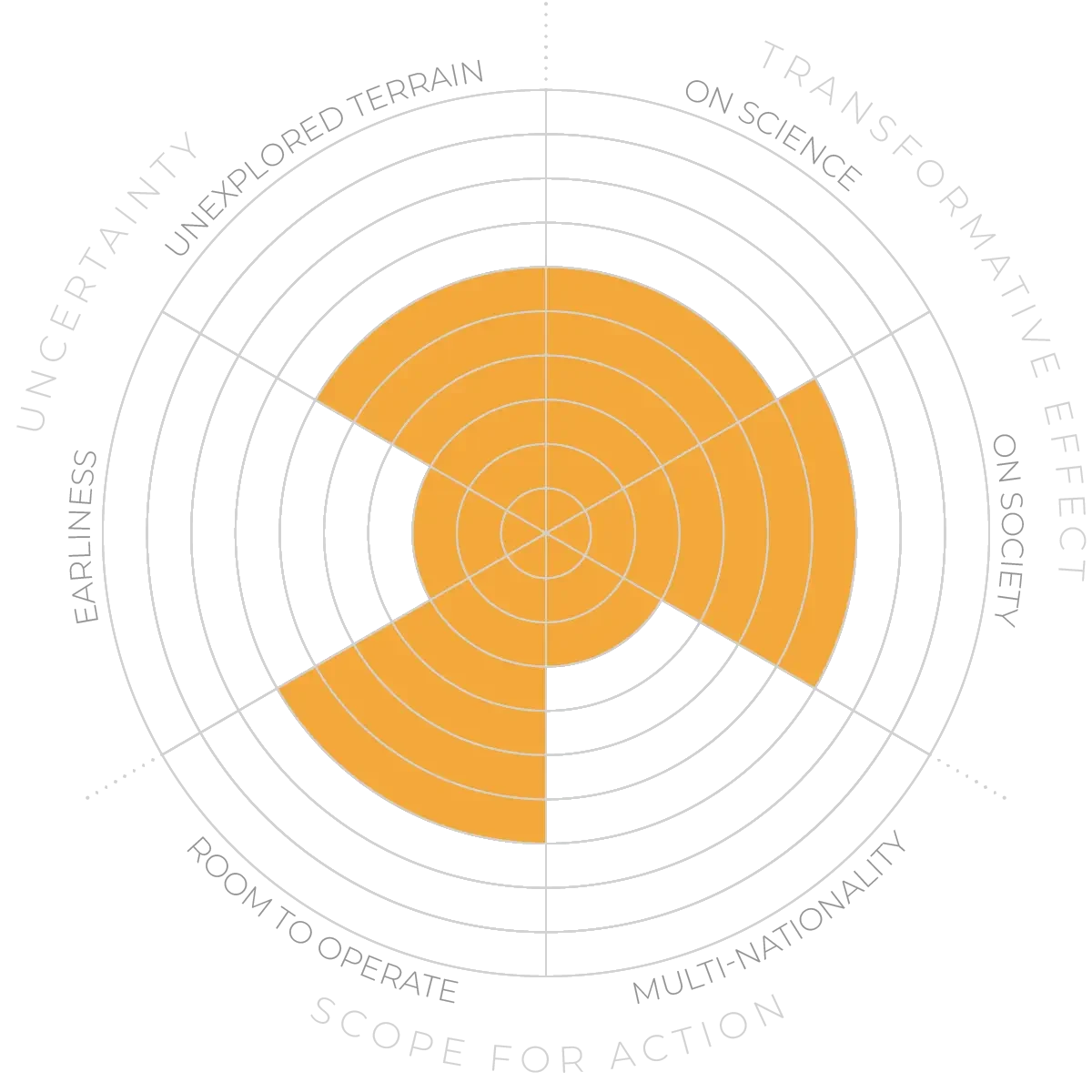
Science diplomacy for effective multilateralism - Anticipation Scores
The Anticipation Potential of a research field is determined by the capacity for impactful action in the present, considering possible future transformative breakthroughs in a field over a 25-year outlook. A field with a high Anticipation Potential, therefore, combines the potential range of future transformative possibilities engendered by a research area with a wide field of opportunities for action in the present. We asked researchers in the field to anticipate:
- The uncertainty related to future science breakthroughs in the field
- The transformative effect anticipated breakthroughs may have on research and society
- The scope for action in the present in relation to anticipated breakthroughs.
This chart represents a summary of their responses to each of these elements, which when combined, provide the Anticipation Potential for the topic. See methodology for more information.

Technology Diplomacy and the role of non-state actors
Future Horizons:
5-yearhorizon
Science diplomacy and technology platforms shape each other
10-yearhorizon
Multi-stakeholder science diplomacy becomes the norm
25-yearhorizon
Private sector actors are integrated in governance
The attempts at influence go both ways, however. Numerous nations (and groups of nations, such as the EU) have created “tech ambassador” roles and deployed these representatives to gather information, lobby and negotiate in Silicon Valley and other technology hubs around the world.3
Sometimes, technology diplomacy has to operate where the lines between nation-states and private companies are blurred, as with China’s Huawei and ZTE. There are also issues with technology companies offering a country a competitive edge or working in areas that involve national security sensitivities, such as supercomputing hardware. Here, tech diplomats must tread the fine line between corporate freedoms, global balances of power and issues of national interest — often with incomplete information due to the unwillingness of all parties to fully disclose all the relevant data.
In some regions, where regulatory environments are weak, lobbyists, activists and grass-roots organisations are pushing the boundaries of science with their work on anti-ageing therapies and gene editing, some of which can influence regulatory policy-making, and sometimes accelerate the pace of change. Even small-scale companies, if they are significant employers in a region, can influence local political decision-making and tech-related legislation.
All of these various initiatives demonstrate the rising importance of transnational, non-state and even individual or small-group actors to local and global governance, something that the field of science and tech diplomacy must navigate. 4 5
Technology Diplomacy and the role of non-state actors - Anticipation Scores
The Anticipation Potential of a research field is determined by the capacity for impactful action in the present, considering possible future transformative breakthroughs in a field over a 25-year outlook. A field with a high Anticipation Potential, therefore, combines the potential range of future transformative possibilities engendered by a research area with a wide field of opportunities for action in the present. We asked researchers in the field to anticipate:
- The uncertainty related to future science breakthroughs in the field
- The transformative effect anticipated breakthroughs may have on research and society
- The scope for action in the present in relation to anticipated breakthroughs.
This chart represents a summary of their responses to each of these elements, which when combined, provide the Anticipation Potential for the topic. See methodology for more information.

Science diplomacy and emerging economies
Future Horizons:
5-yearhorizon
Emerging economies invest in science diplomacy training
10-yearhorizon
Trained science diplomats are spread through relevant organisations
25-yearhorizon
Emerging economies gain increasing influence over Big Science
There are, however, significant collaborations that involve exclusively emerging economies. Intergovernmental science organisations such as the African Lightsource, the Synchrotron-Light for Experimental Science and Applications in the Middle East (SESAME) — a joint undertaking of Israel, the Palestinian Territories, Egypt, Jordan, Iran, Pakistan, Turkey and Cyprus — and the Latin American and Caribbean Space Agency are all good examples of nations with emerging economies engaging in multilateral science diplomacy on their own terms.
The value of such endeavours in establishing credentials for global engagement is clear from South Africa’s success with the Square Kilometre Array (SKA), a radio-telescope project that is showcasing the nation’s science and engineering talent, creating programmes to further develop its human capital and burnishing its reputation as a rising power on the world economic and intellectual stage. Although there are hurdles to overcome, there are clear reasons to encourage and pursue more such inclusive collaborations between countries of differing economic means.8 At the same time, more and more emerging economies are taking an interest in science diplomacy as a means of moving towards greater scientific and technological development
Science diplomacy and emerging economies - Anticipation Scores
The Anticipation Potential of a research field is determined by the capacity for impactful action in the present, considering possible future transformative breakthroughs in a field over a 25-year outlook. A field with a high Anticipation Potential, therefore, combines the potential range of future transformative possibilities engendered by a research area with a wide field of opportunities for action in the present. We asked researchers in the field to anticipate:
- The uncertainty related to future science breakthroughs in the field
- The transformative effect anticipated breakthroughs may have on research and society
- The scope for action in the present in relation to anticipated breakthroughs.
This chart represents a summary of their responses to each of these elements, which when combined, provide the Anticipation Potential for the topic. See methodology for more information.
Science diplomacy in an era of conflict
Future Horizons:
5-yearhorizon
Science diplomacy becomes a hard tool in international relations
10-yearhorizon
Science facilities opened up to scientists displaced by conflict
25-yearhorizon
Science diplomacy improves international relations
Science is certainly affected by conflict. The war in Ukraine, for example, has hindered some collaborations between scientists of different nations: because of Russia’s geographical position, these stymied collaborations are having direct effects on Arctic science and are likely to affect protections against exploitation of Arctic resources.9
Science has recently become part of broader policies of sanctions between nation-states, as technology has become an interestingly important element of successful economies. More positively, it may be possible for scientists — working with science-diplomacy resources — to become drivers of positive change, shaping global research to give more equitable benefit from the outcomes of science.
Science diplomacy in an era of conflict - Anticipation Scores
The Anticipation Potential of a research field is determined by the capacity for impactful action in the present, considering possible future transformative breakthroughs in a field over a 25-year outlook. A field with a high Anticipation Potential, therefore, combines the potential range of future transformative possibilities engendered by a research area with a wide field of opportunities for action in the present. We asked researchers in the field to anticipate:
- The uncertainty related to future science breakthroughs in the field
- The transformative effect anticipated breakthroughs may have on research and society
- The scope for action in the present in relation to anticipated breakthroughs.
This chart represents a summary of their responses to each of these elements, which when combined, provide the Anticipation Potential for the topic. See methodology for more information.

Citations
Science diplomacy for effective multilateralism
- D. Gehrt. Does Science Diplomacy Work in Highly Competitive Technology Areas? An Analysis of the EU’s S&T Cooperation with China in the Field of Solar Photovoltaics https://www.sciencediplomacy.org/article/2019/does-science-diplomacy-work-in-highly-competitive-technology-areas-analysis-eus-st
- N. Sciences. Important Changes: Implementation of the Policy on Sensitive Technology Research and Affiliations of Concern https://www.nserc-crsng.gc.ca/Media-Media/NewsDetail-DetailNouvelles_eng.asp?ID=1456
Technology Diplomacy and the role of non-state actors
- C. Klynge,. Diplomacy in the Digital Age: Lessons from Denmark’s TechPlomacy Initiative https://doi.org/10.1163/1871191X-15101094
- M. Acuto,. City Diplomacy: Towards More Strategic Networking? Learning with WHO Healthy Cities https://doi.org/10.1111/1758-5899.12382
- A. Roig,. Barcelona’s Science Diplomacy: Towards an Ecosystem-Driven Internationalization Strategy https://doi.org/10.1057/s41599-020-00602-y
Science diplomacy and emerging economies
- A. Åberg. The Ways and Means of ITER: Reciprocity and Compromise in Fusion Science Diplomacy https://doi.org/10.1080/07341512.2021.1891851
- K. E.. Accelerating Basic Science in an Intergovernmental Framework: Learning from CERN’s Science Diplomacy https://doi.org/10.1111/1758-5899.12589
- A. Polejack. Where is the Global South in the Science Diplomacy Narrative? http://dx.doi.org/10.2139/ssrn.4278557
Science diplomacy in an era of conflict
- E. López-Blanco. Towards an increasingly biased view on Arctic change https://doi.org/10.1038/s41558-023-01903-1